
Key takeaways
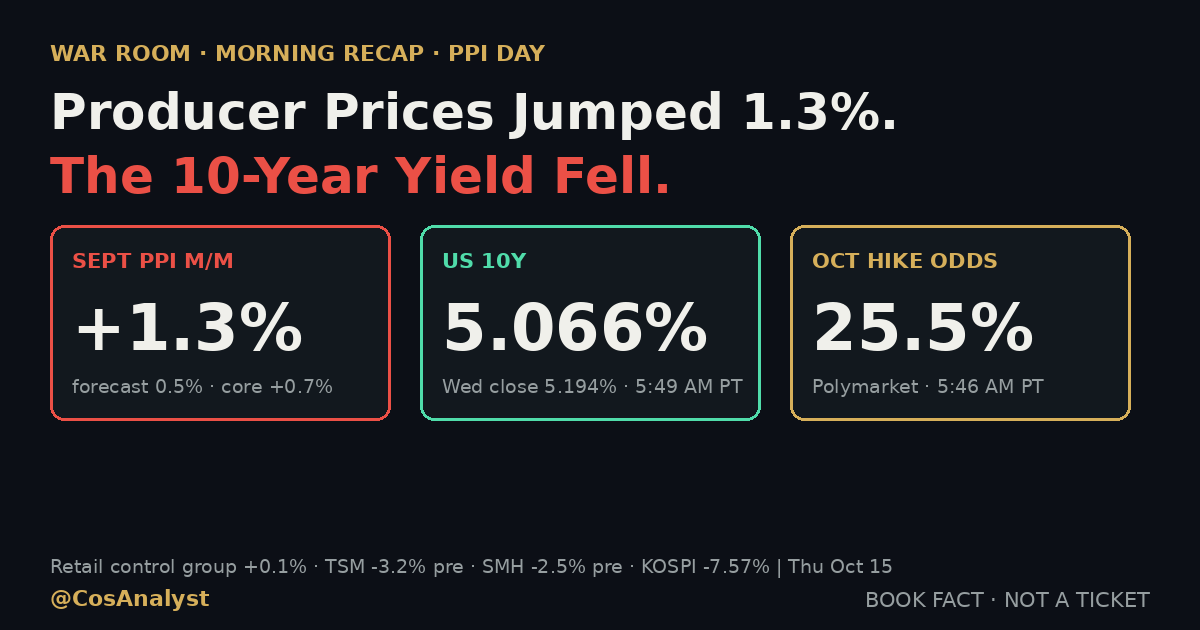
- September PPI rose 1.3% month over month against a 0.5% forecast. Core PPI rose 0.7% against 0.3%. The 12-month rate is 6.3% (BLS).
- The 10-year Treasury yield fell anyway: 5.066% at 5:49 AM PT, down 12.8 basis points from Wednesday's 5.194% close (TradingView).
- Retail sales rose 0.8% against 0.3%, but the control group, the GDP input, rose only 0.1% against 0.3% (Census Bureau).
- TSMC posted record third-quarter results and chip stocks sold anyway: TSM -3.2%, SMH -2.5% and QQQ -1.2% premarket, while RSP, XLP and XLV are green.
- October hike odds are 25.5% on Polymarket. Fed Chair Kevin Warsh speaks tonight at 8:30 PM PT, and the market heads into Friday's monthly options expiration leaning negative gamma.
Producer prices rose 1.3% in September, the biggest monthly jump since March 2022, and the bond market bought them anyway. Nothing about the PPI print was close. The forecast was 0.5%. Core was supposed to be 0.3% and came in at 0.7%. By 5:49 AM PT the 10-year Treasury yield was 5.066%, down 12.8 basis points from Wednesday's close, and October Fed hike odds were lower than they were before the number hit.
For the second straight day, a hot inflation print has failed to push long yields up. Wednesday's hot core CPI sank tech. Thursday's PPI is a much bigger miss, and the equity damage is again concentrated in chips and the Nasdaq, not in the whole market. SPY is indicated down 0.29% at 767.36, QQQ down 1.18% at 720.32, and IWM is up 0.08% at 271.60, all premarket against Wednesday's closes (SPY 769.60, QQQ 728.95, IWM 271.37).
September PPI 2026: producer prices jump 1.3%, core PPI 0.7%
The Bureau of Labor Statistics reported at 8:30 AM ET that the Producer Price Index for final demand "increased 1.3 percent in September, seasonally adjusted," after 0.5% in August and 0.2% in July. The BLS called it the largest advance since a 1.7% rise in March 2022. On an unadjusted basis, final demand climbed 6.3% over the 12 months ended in September, "the largest 12-month increase since moving up 6.4 percent in December 2022." The forecast for the annual rate was 5.3%, and the prior reading was 5.6%.
| Measure (September) | Actual | Forecast | Prior |
|---|---|---|---|
| PPI, month over month | +1.3% | 0.5% | 0.5% |
| PPI, year over year | 6.3% | 5.3% | 5.6% |
| Core PPI (less foods and energy), month over month | +0.7% | 0.3% | 0.2% |
| Core PPI, year over year | 5.0% | 4.4% | 4.8% |
| Retail sales, month over month | +0.8% | 0.3% | 1.3% |
| Retail sales ex autos, month over month | +0.9% | 0.5% | 1.4% |
| Retail sales control group, month over month | +0.1% | 0.3% | 1.2% |
Actuals from BLS and Census; forecasts and priors from the TradingView economic calendar. Core PPI here is final demand less foods and energy.
Energy did most of the work. Final demand goods rose 2.6%, which the BLS says is the largest increase since the series began in December 2009, and over 80 percent of that rise came from final demand energy, up 10.8%. Gasoline alone jumped 20.3%. With $WTI near $95, that is the same $WTI shock that has kept headline inflation hot all year. Our Wednesday close recap covers how that fed into CPI.
But this was not only an energy print. Final demand services rose 0.8%, with trade margins up 1.4% and transportation and warehousing up 3.4%. Strip out food and energy and prices still rose 0.7%, with a 5.0% annual rate. Even the narrowest cut, final demand less foods, energy and trade services, rose 0.5% on the month after 0.3% in August, and sits at 5.0% year over year. That is why we call it very hot pipeline inflation, not a one-commodity story.
The 10-year Treasury yield fell anyway
Hot pipeline prices should push long yields higher. They did the opposite. The 10-year yield sat at 5.066% at 5:49 AM PT, down 12.8 basis points from Wednesday's 5.194% close, and the 2-year was 4.764%, down 4.2 basis points. The dollar index is down 0.37% near 102.15 and gold is up 0.96% near $4,145.
Here is our read. Bond traders looked through the producer-price number for two reasons. First, the biggest piece was energy, which markets already knew about. Second, the demand side of the morning did not confirm an overheating economy, as the retail sales control group below shows. The market is leaning toward a growth and AI-funding scare more than toward a Fed forced to hike. It is a read, not a certainty, and it can flip on a single speech tonight. Yields are also still above 5%, so "falling" is relative.
This is the same split our Seoul circuit breaker note flagged overnight: hot data, falling long yields, falling equities. PPI did not resolve it. It deepened it.
Retail sales and the control group: more dollars, not more stuff
Retail sales rose 0.8% in September against a 0.3% forecast, and August was revised up to 1.3% (Census Bureau). Ex autos, sales rose 0.9% against 0.5%. On the surface that reads as a strong consumer. The control group, which excludes autos, gas stations, building materials and food services and feeds directly into the government's goods-spending estimate for GDP, rose just 0.1% against 0.3% and after 1.2% the prior month.
Census reports retail sales in nominal dollars, not adjusted for price changes. With gasoline prices jumping at the producer level, a strong headline and a weak control group is consistent with this: shoppers spent more and did not buy much more. That is a stagflation-flavored mix, and it helps explain why bonds shrugged at a 1.3% PPI. The rest of the morning was noisy. The Empire State index jumped to 25.5 against a 10.3 forecast, the Philadelphia Fed index slipped to 20.9 against 28.4, and initial jobless claims were 199,000 against 200,000.
TSMC earnings Q3 2026: a record quarter, and chip stocks sold anyway
TSMC reported third-quarter revenue of NT$1,494.24 billion, or US$46.72 billion, up 50.9% in Taiwan dollars and 41.2% in US dollars from a year earlier. Net income was NT$763.06 billion, up 68.7%, or US$4.60 per ADR unit. Gross margin was 66.4% and operating margin 58.7%, both inside or above the company's guidance. For the fourth quarter TSMC guided revenue to US$52.3 billion to US$54.3 billion, and said 2026 revenue should grow around 44% in US dollars (TSMC investor relations). CNBC called it a record profit for a sixth straight quarter, ahead of LSEG estimates.
The stock still opened the day in the red. The TSM ADR is down about 3.2% premarket near $416. That is the chip stocks selloff in one picture: the best earnings in the sector are not enough while the AI-funding question hangs over the group. SMH, the chip ETF, is down 2.54% at 550.42, below Wednesday's 564.74 close. Micron is down 4.30%, AMD down 3.33% and Nvidia down 1.83%. Memory names are following Seoul, where SK hynix closed down 11.1% and Samsung down 9.5% on Thursday.
Rotation, not a crash
Look at what is rising. Premarket, the equal-weight S&P 500 (RSP) is up 0.48%, consumer staples (XLP) up 1.66% and health care (XLV) up 1.17%, against technology (XLK) down 1.61% and SMH down 2.54%. VIX is 17.49, up 3.7% and still well short of a panic reading. This looks like money leaving the AI and semiconductor trade for defensives, not a market-wide dash for the exits.
| Premarket, Thu Oct 15 | Level | Change vs Wed close |
|---|---|---|
| SPY | 767.36 | -0.29% |
| QQQ | 720.32 | -1.18% |
| IWM | 271.60 | +0.08% |
| SMH | 550.42 | -2.54% |
| RSP (equal weight) | 213.11 | +0.48% |
| XLP (staples) | 87.49 | +1.66% |
| XLV (health care) | 176.00 | +1.17% |
| XLK (technology) | 187.37 | -1.61% |
| VIX | 17.49 | +3.7% |
TradingView, about 5:49 AM PT. ETFs premarket; VIX and yields are live marks.
Asia broke first: KOSPI and the Nikkei
The overnight lead-in was brutal. South Korea's KOSPI closed at 5,554.22, down 7.57%, after a circuit breaker. Japan's Nikkei closed at 64,425.73, down 4.90%, and the Hang Seng slipped about 1.0%. We covered the halt and the history it rhymes with in the Seoul note. The point for this morning is that Asia's chip wipeout was the setup, and PPI did not repair it.
Fed rate hike odds for October: Kevin Warsh speaks tonight
A 1.3% PPI did not move the Fed crowd. Polymarket prices a 25 basis point hike at the Oct 27-28 meeting at 25.5% as of 5:46 AM PT, with no change at 74.5%. That is lower than Wednesday's 30.5% close and roughly where it stood before the print (about 27.5% at 5:20 AM PT, per our desk check). December is a different story: a 25 basis point hike is 79.5%, and Polymarket still sees another hike in 2026 as very likely (85.5% at 5:45 AM PT). The market says a hike is coming, just not necessarily in October.
Which brings us to tonight. Fed Chair Kevin Warsh speaks at 8:30 PM PT (11:30 PM ET), after the cash close, and it is the highest-importance event of the week for October odds. Patience language would fit the growth-scare bid in bonds. Urgency language would put the PPI number back in front, and Friday's open would have to price it. For context on the odds and how we read them, see our October and December hike odds note.
Options expiration Friday: negative gamma and the call walls
Positioning adds fuel. Through Friday's monthly expiration, our desk's read of dealer positioning in both SPY and QQQ leans negative gamma, and in that regime hedging flows tend to amplify moves instead of damping them. If you want the mechanics, our explainers on positive versus negative gamma and gamma exposure lay it out.
The call walls, the strikes where call open interest is heaviest, sit at 785 in SPY and 760 in QQQ, well above Thursday's premarket levels of 767 and 720. Put open interest is heavy into Friday, with SPY put walls at 750 and 738 and QQQ put walls at 700 and 690. Before the print, at-the-money straddles priced a move of about 0.69% in SPY and 1.47% in QQQ for Thursday, and about 0.93% and 1.77% through Friday (CosAnalyst desk, delayed CBOE chain, about 5:20 AM PT). QQQ is already trading inside its Thursday implied move.
What to watch today and tomorrow
- Thu Oct 15, 7:00 AM PT (10:00 AM ET): business inventories.
- Thu Oct 15, 8:00 AM PT (11:00 AM ET): Atlanta Fed GDPNow Q3 update, prior 3.6%.
- Thu Oct 15, 9:00 AM PT (12:00 PM ET): EIA crude stocks, a $WTI catalyst.
- Thu Oct 15, 1:30 PM PT (4:30 PM ET): Fed's Hammack speaks.
- Thu Oct 15, 8:30 PM PT (11:30 PM ET): Fed Chair Warsh speaks.
- Fri Oct 16: import and export prices at 5:30 AM PT, industrial production at 6:15 AM PT, and monthly options expiration.
- Oct 21: Tesla earnings. Oct 27-28: FOMC meeting.
How we read the scenarios
- Yields keep falling and chips keep selling: the growth and AI-funding read owns the tape, and defensives stay bid.
- Yields reverse higher after the open: the PPI number is back in front, October odds firm, and QQQ is the pressure point.
- Chips hold above Wednesday's SMH close of 564.74 and QQQ recovers: the selloff was an overnight Asia echo, not a new leg.
We do not know which of these wins. We know the questions: do bonds keep looking through inflation, and does the AI trade stabilize before Warsh and Friday's expiration.
FAQ
What did September PPI show?
The Producer Price Index for final demand rose 1.3% in September against a 0.5% forecast, the largest monthly gain since March 2022, and 6.3% year over year (BLS). Core PPI, less foods and energy, rose 0.7% against a 0.3% forecast and 5.0% over 12 months. Energy prices rose 10.8% and gasoline 20.3%.
Why did the 10-year Treasury yield fall after a hot PPI?
The 10-year yield fell to 5.066% from 5.194% because bond traders appear to be looking through energy-driven producer prices toward weaker demand, shown by the 0.1% retail sales control group, and toward growth and AI-funding stress after Asia's selloff. The yield is still above 5%.
Why are chip stocks selling off after TSMC earnings?
TSMC reported record third-quarter results, with revenue of US$46.72 billion and net income up 68.7%, but the TSM ADR is down about 3.2% premarket and SMH is down about 2.5%. Chips are being sold on AI-funding worries and the KOSPI circuit breaker, not on a TSMC miss, even as defensives rise.
What are the Fed rate hike odds for October, and when does Kevin Warsh speak tonight?
Polymarket priced a 25 basis point hike at the October 27-28 meeting at 25.5% at 5:46 AM PT, with no change at 74.5% and a December hike at 79.5%. Fed Chair Kevin Warsh speaks tonight at 8:30 PM PT (11:30 PM ET). Friday Oct 16 is monthly options expiration.
Follow the desk
Follow @CosAnalyst on X for the read on Warsh and Friday's expiration as they land. Join the free Telegram alerts channel, Free Index & BTC Trade Alerts. Wednesday Oct 14 had 0 fires in the free channel, and sitting out when the setup is not there is part of the plan. Nothing there is financial advice.
BOOK FACT · NOT A TICKET. CosAnalyst research and analysis, not financial advice or a trade recommendation. PPI figures and quotes are from the BLS Producer Price Index news release for September 2026 (8:30 AM ET, Oct 15). Forecasts and prior readings are from the TradingView economic calendar. Retail sales are from the Census Bureau advance report, in nominal dollars. TSMC results and guidance are from TSMC investor relations, with the record-profit and estimate comparison from CNBC. Quotes, sectors, yields, dollar, gold and VIX are TradingView marks at about 5:49 AM PT, Thu Oct 15, 2026, with ETFs and stocks premarket. Wednesday closes are TradingView daily closes. Asia closes (KOSPI, Nikkei, SK hynix, Samsung) are Thursday session closes via TradingView. Fed odds are from Polymarket as of about 5:46 AM PT. Options-implied moves and call and put walls are from the CosAnalyst desk using a delayed CBOE chain. Prediction-market odds and market data change quickly.