
Hot core CPI was supposed to mean one thing: higher yields and a hawkish Fed. Wednesday delivered the print. Core rose 0.3% month over month and 2.6% year over year, a tenth above consensus on both. Headline hit 3.7% against 3.6% expected (BLS). Semiconductors led the US selloff. $SMH closed down 3.98% at $564.74. $QQQ fell 1.97% to $728.95. $SPY lost 1.08% to $769.60.
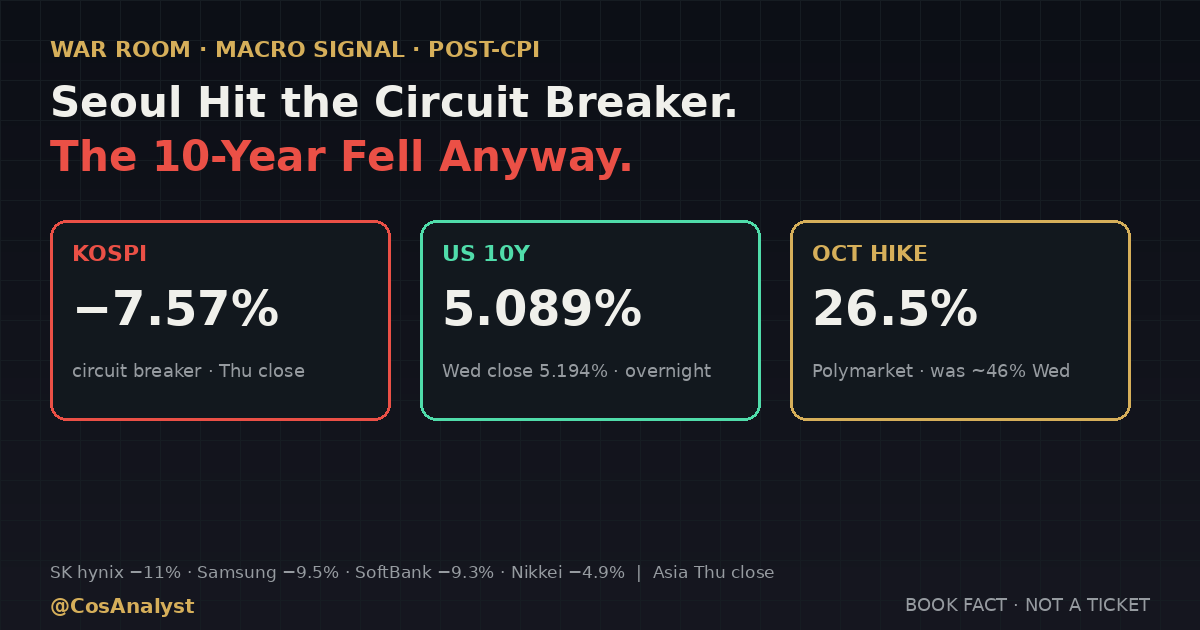
Then Asia opened Thursday and finished the job New York started. South Korea's KOSPI closed at 5,554.22, down 7.57%. SK hynix closed down 11.1%. Samsung Electronics closed down 9.5%. SoftBank Group closed down 9.3%. Japan's Nikkei closed at 64,425.73, down 4.90%. Korea Herald and local wires reported a sell-sidecar early and a circuit breaker that halted trading for 20 minutes. It was not a quiet overnight gap. The market stopped.
Here is the disagreement. The equity market, especially Asia's AI-hardware complex, is pricing a funding and growth scare on top of Wednesday's Fed reprice. The bond market is not punishing with higher long rates. It is buying them. The 10-year yield closed Wednesday at 5.194%. By about 1:07 AM PT Thursday it was trading near 5.089%. Gold was up about 1.1% near $4,149. The dollar index was soft near 102.03. Polymarket's odds of a 25 basis point hike at the Oct 27-28 meeting, which spiked toward the mid-40s right after the CPI print on Wednesday, sat near 26.5% overnight. The tape is not doubling down on a hiking Fed. It sold the AI-capex trade and ran into duration.
What Wednesday set up
The CPI report did what a hot core print does. The 2-year Treasury yield, the maturity most tied to Fed policy, spiked as high as 4.95% on Wednesday before closing at 4.806% (TradingView daily bars). Polymarket's October hike contract jumped from about 18% before the print to as high as 46.5% in the morning, then settled near the low-30s by midday (as logged in our Wednesday CPI recap). $SMH, $QQQ and Micron ($MU, −4.1% to $914.13) took the rate-sensitive hit.
Asia inherited that tape and added its own fear: that higher funding costs hit the AI buildout before they hit the Fed's next press conference. Dow Jones and Reuters overnight headlines framed the move as AI-debt and Fed-hike concerns in the same breath. For SK hynix and Samsung, that is the same nerve Tuesday already hit, when memory stocks cracked and KOSPI broke its 200-day average while the S&P barely moved.
Five stress signals
- 1. KOSPI closed −7.57% at 5,554.22, with a sidecar and a circuit breaker. Tuesday's break of the 200-day near 6,385 was the warning. Thursday was the confirmation. The index is now roughly 39% below its June 22 peak of 9,114.55 (TradingView).
- 2. Memory makers led again. SK hynix −11.1% to 1,262,000 won. Samsung −9.5% to 210,000 won. SoftBank −9.3% to 4,852 yen. This is the hardware stack that US semis track with a lag.
- 3. US chips already joined on Wednesday. $SMH closed at $564.74, under Monday's $590.99 line we flagged Tuesday. $QQQ closed at $728.95. Micron closed at $914.13. New York stopped yawning the moment CPI forced rates into the same story as chips.
- 4. The 10-year fell while Asia broke. Wednesday close 5.194%. Overnight near 5.089% as of 1:07 AM PT. A hot inflation print that ends with lower long yields is pricing slower growth or tighter financial conditions, not a simple "higher for longer" victory lap.
- 5. October hike odds cooled overnight. Polymarket Oct +25 bp near 26.5% and no-change near 74.5% as of about 1:07 AM PT. December +25 bp still near 78.5%. The market still expects another hike this year. It is less sure the October meeting is the one.
The history this rhymes with
On Tuesday we cited @themarketear's read: the last time KOSPI broke below its 200-day average, US semis ended up about 12% lower. Their question was "who's right?" Tuesday, New York shrugged. Wednesday, hot CPI made New York join. Thursday, Seoul hit the breaker.
That sequence matters. Korea sits early in the memory supply chain. When the KOSPI signal fires and then a macro shock arrives in the same week, the US chip complex usually stops treating Korea as local color. From Monday's $SMH close of $590.99, a 12% drawdown would land near $520. We are not forecasting that number. We are noting that the signal is no longer theoretical. Score the claim we already made: $SMH closes Friday, Oct 16 below $590.99.
Why bonds and Asia disagree with the simple Fed story
If this were only a Fed-hike scare, you would expect the long end to sell off with the front end, the dollar to firm, and gold to soften. Overnight marks do the opposite. The 2-year has backed off Wednesday's 4.95% spike to about 4.73%. The 10-year is lower. Gold is higher. The dollar is softer. Oil is softer near $94. Futures are heavy, with Nasdaq futures still about 1.25% under Wednesday's settle, but the rates complex is not confirming a pure hawkish reprice.
Wednesday's CPI opened the door to an earlier hike. Asia and US chips priced the second-order risk, that AI capex and memory margins do not love higher funding costs. Bonds overnight are pricing that growth and funding stress more than they are pricing a determined hiking cycle. Both can be true for a day. They cannot both be the dominant story forever. Thursday's data and Fed Chair Warsh tonight decide which one wins the week.
What to watch
- 1. PPI and retail sales, Thursday 5:30 AM PT. Hot PPI plus firm retail sales would push the Fed story back in front. Soft prints would let the growth-scare bid in bonds keep running.
- 2. $SMH versus Wednesday's close of $564.74. Holding under it keeps the chip break intact. Reclaiming Monday's $590.99 by Friday is still the cancel line on our Tuesday claim.
- 3. 10-year versus 5.19%. That was Wednesday's close. Holding under it overnight into the US open keeps the growth-scare read alive. A move back through 5.25% would say the Fed story is back in charge.
- 4. 2-year versus 4.95%. Wednesday's spike high. If the 2-year reclaims it after PPI, October odds likely firm again.
- 5. Fed Chair Warsh, Thursday 8:30 PM PT. Highest-importance Fed voice of the week for October odds. Patience language cools the hike tape. Urgency language puts Asia's Thursday back on the US cash market Friday.
How to prepare
- 1. Treat chips as the live risk, not a Korea footnote. If you own $QQQ or the S&P, you own this.
- 2. Watch whether yields and chips move together after 5:30 AM PT. If they move the same way, one story owns the open. If they split, the disagreement is still live.
- 3. Decide before Warsh what would change your read. Not after the quote hits the terminal.
Takeaway
Tuesday Seoul cracked and New York yawned. Wednesday CPI made New York join. Thursday Seoul hit the circuit breaker, and the 10-year fell anyway. The simple story is a hotter Fed. The tape overnight is pricing something harder: a break in the AI-funding trade that pulls long yields down, not up. PPI, retail sales and Warsh will say which story owns the rest of the week.
If you want our free research notes as they land, join the Cos Analyst Signals channel on Telegram: https://t.me/CosAnalystSignals. It is free, and nothing there is financial advice.
BOOK FACT · NOT A TICKET. CosAnalyst research. Not financial advice. Asia closes (KOSPI, Nikkei, SK hynix, Samsung, SoftBank) are Thursday Oct 15, 2026 session closes via TradingView. Wednesday US ETF closes ($SMH, $QQQ, $SPY, $MU) are Wed Oct 14 closes via TradingView. Yields, gold, DXY, VIX and futures are TradingView marks as of about 1:07 AM PT, Thu Oct 15, 2026. September CPI from BLS. Polymarket October and December hike odds as of about 1:07 AM PT via Polymarket gamma API. Circuit-breaker and sidecar detail from Korea Herald and TradingView news headlines. Third-party figures are credited to their sources.