
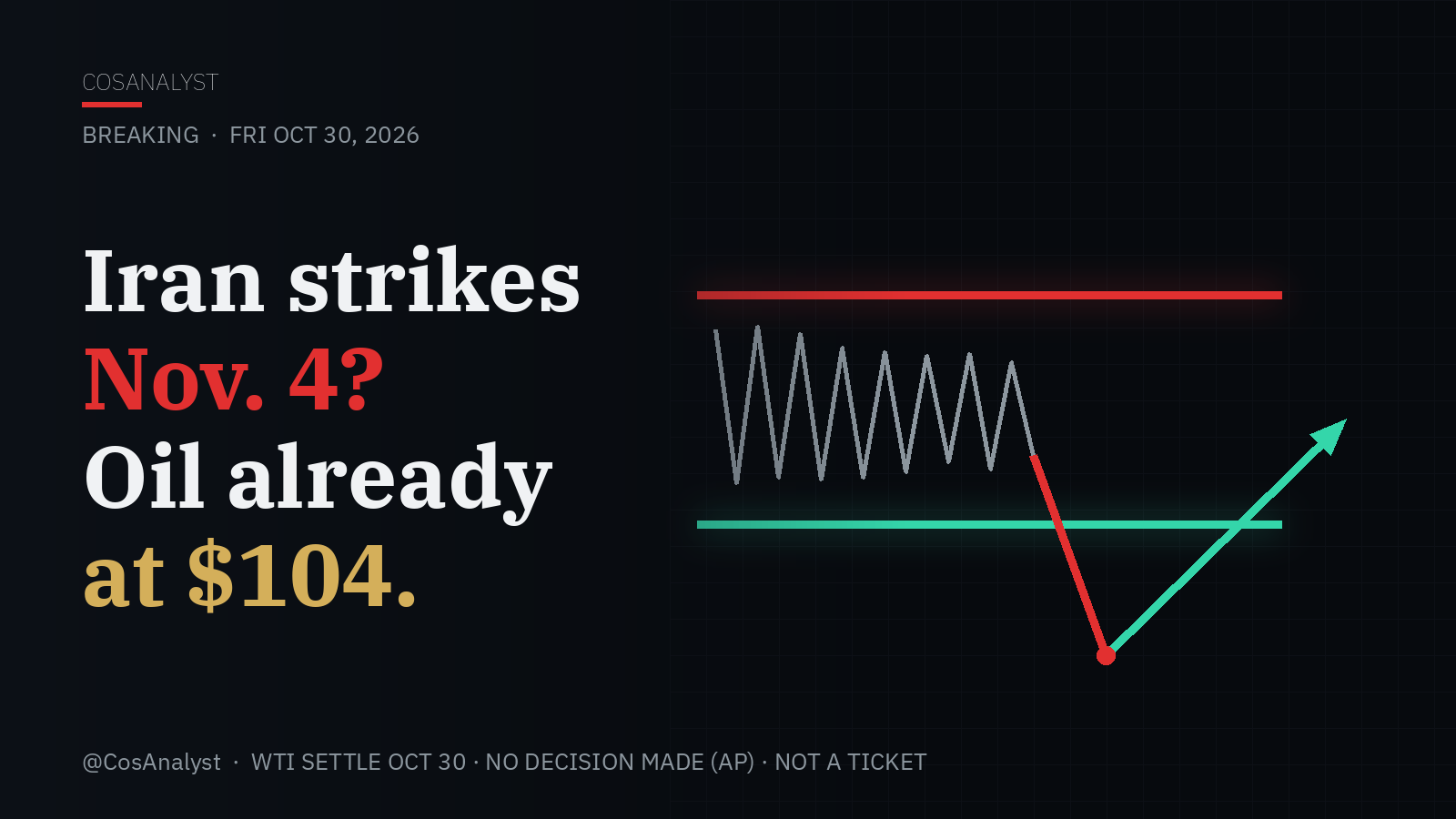
Wall Street spent Friday selling chip stocks. The oil market spent it pricing a war. Late Friday, MS NOW reported that the Trump administration has told Gulf allies to prepare for a short, intense round of U.S. strikes on Iran as soon as Wednesday, Nov. 4, the day after the midterm elections. No strike has been ordered. A White House official told MS NOW it does not comment on military plans that "may or may not exist." But crude had already settled at a six-month high, and stock and oil futures stay shut until Sunday afternoon.
Will the US strike Iran after the midterms?
Nobody outside the White House knows, and the reporting says Trump has not decided. Here is what has been reported. MS NOW, citing three senior Gulf Arab officials, said Gulf allies were briefed to prepare for "a short, intense round of strikes as soon as Nov. 4." The Wall Street Journal reported the briefings first. Walter Bloomberg relayed the MS NOW report on X at 3:34 PM PT Friday.
Two days earlier, the Associated Press reported that U.S. officials told regional allies to prepare for renewed military action after the election and for possible Iranian retaliation. Two diplomats told AP the new round could last several days, that allies were urged to protect energy facilities and other critical infrastructure, and that Trump has made no final decision. Axios reported that a U.S. official said Trump might be more inclined to act if Republicans lose badly, while a White House official said election results will not factor into the decision.
Iran strikes November 4: what we know and what we don't
- Reported: Gulf allies told to prepare for strikes as soon as Nov. 4 (MS NOW, three Gulf officials).
- Reported: strikes could last several days; allies urged to harden energy sites (AP, two diplomats).
- Reported: the U.S. is sending a third carrier strike group, led by the USS Theodore Roosevelt, with about 9,000 sailors and Marines; U.S. officials said those forces arrive at the end of November (MS NOW, AP).
- Reported: extra Patriot missile-defense batteries moved to Saudi Arabia and Qatar, and most U.S. government staff ordered out of Saudi Arabia (MS NOW).
- Not confirmed: any order to strike. The U.S. has not struck Iran since Sept. 1 (MS NOW).
- Not known: the targets, the timing, or whether some Gulf states would refuse use of their bases. One Gulf official told MS NOW they "would not be surprised" if some pushed back.
Is there still a diplomatic way out?
Talks are still running. Axios reported that Qatari mediators spent more than 12 hours in Tehran on Friday, with a diplomatic source citing "positive progress," and that talks move to Doha on Saturday. MS NOW reported that Vice President JD Vance sent a letter proposing a meeting with Iranian security chief Mohsen Rezaei. Iran's foreign minister Abbas Araghchi wrote on X on Wednesday that Tehran "continues to give diplomacy a chance to succeed" and is reviewing ideas with mediators (AP). The UAE foreign ministry urged both sides to "exercise wisdom" and pursue political solutions (AP).
What will oil prices do Monday?
No one can say, and we will not guess a number. What we can show is where oil starts. On Friday, Oct. 30, WTI settled up $2.12 (2.08%) at $104.12, and the expiring December Brent contract settled up $2.76 (2.4%) at $117.64 after touching $118 (CNBC/Reuters). The more active January Brent contract settled at $113.43. Those were the highest settles since late April. For October, Brent rose 13.6% and WTI 15.2%.
The tape was already reacting to the Strait of Hormuz. Britain's UKMTO said a tanker was hit by explosives attached by a small boat, which maritime sources called the first successful limpet-mine strike in the strait since the war began in February (CNBC/Reuters). Iran's Revolutionary Guard said a supertanker hit a naval mine on an "unauthorised route" (The National). Newsquawk noted WTI traded between $102.43 and $104.99 on Friday, and that crude dipped on deal headlines before settling higher.
Why energy infrastructure matters for prices: Axios reported Iran has vowed to answer any U.S. strike on its energy infrastructure by hitting oil and gas facilities in Saudi Arabia, the UAE, Qatar, Kuwait and Bahrain. That is the supply risk the market is weighing. A deal headline from Doha is the other side of the same trade.
Stock market election week: what to watch
Stocks closed Friday before the MS NOW report. The S&P 500 fell 1.82% and the Nasdaq 2.86% on Intel's guidance, while energy was the best sector, with the XLE ETF up 1.91% (our close recap). The first market read on the Iran report comes when CME stock and oil futures reopen Sunday at 3:00 PM PT (6:00 PM ET). Clocks fall back on Sunday, Nov. 1.
| Day | Time (PT) | Event |
|---|---|---|
| Sat Oct 31 | Qatar-led U.S.-Iran talks continue in Doha (Axios) | |
| Sun Nov 1 | 3:00 PM | CME futures reopen |
| Mon Nov 2 | 7:00 AM | ISM manufacturing |
| Mon Nov 2 | After close | Apple fiscal Q4 results (call 2:00 PM) |
| Tue Nov 3 | All day | U.S. midterm elections |
| Wed Nov 4 | Earliest strike date cited by Gulf officials (MS NOW) | |
| Fri Nov 6 | 5:30 AM | October jobs report (BLS) |
Sources: MS NOW, Axios, CME, ISM, Apple, BLS.
FAQ
Will the US strike Iran on November 4?
It is not decided. MS NOW reported on Oct. 30, 2026 that Gulf allies were told to prepare for short, intense U.S. strikes as soon as Nov. 4, citing three Gulf officials. AP's sources said Trump has made no final decision, and the White House declined to comment on military plans.
Why are oil prices so high right now?
WTI settled at $104.12 and December Brent at $117.64 on Oct. 30, 2026, their highest settles since late April, per CNBC and Reuters. Traders priced the risk of renewed strikes after the midterms, and a tanker was hit by limpet mines in the Strait of Hormuz on Friday.
When do oil and stock futures open again?
CME stock index and crude futures reopen Sunday, Nov. 1 at 3:00 PM PT (6:00 PM ET), after U.S. clocks fall back. That is the first market reaction to the MS NOW report, which came out after Friday's settlement and the stock market close.
Are US and Iran still negotiating?
Yes, through mediators. Axios reported Qatari mediators held more than 12 hours of talks in Tehran on Friday with "positive progress" and that talks continue in Doha on Saturday. Iran's foreign minister said Tehran continues to give diplomacy a chance. Saudi Arabia and Turkey urged Trump to allow more time.
Sources and disclaimer
Disclaimer: This article is for informational and educational purposes only and is not financial advice. It does not predict whether military action will happen. Do your own research or talk to a licensed professional before making investment decisions.
Sources: MS NOW (Oct. 30), Associated Press via WBBH (Oct. 28), Axios (Oct. 28 and Oct. 31), Wall Street Journal (as cited by MS NOW and AP), CNBC/Reuters (oil settlements), The National, Newsquawk, Walter Bloomberg on X. Times are Pacific. Report last checked 9:15 PM PT Oct. 30.
Follow @CosAnalyst on X for live market reads, and join our free Telegram channel @CosAnalystSignals.