
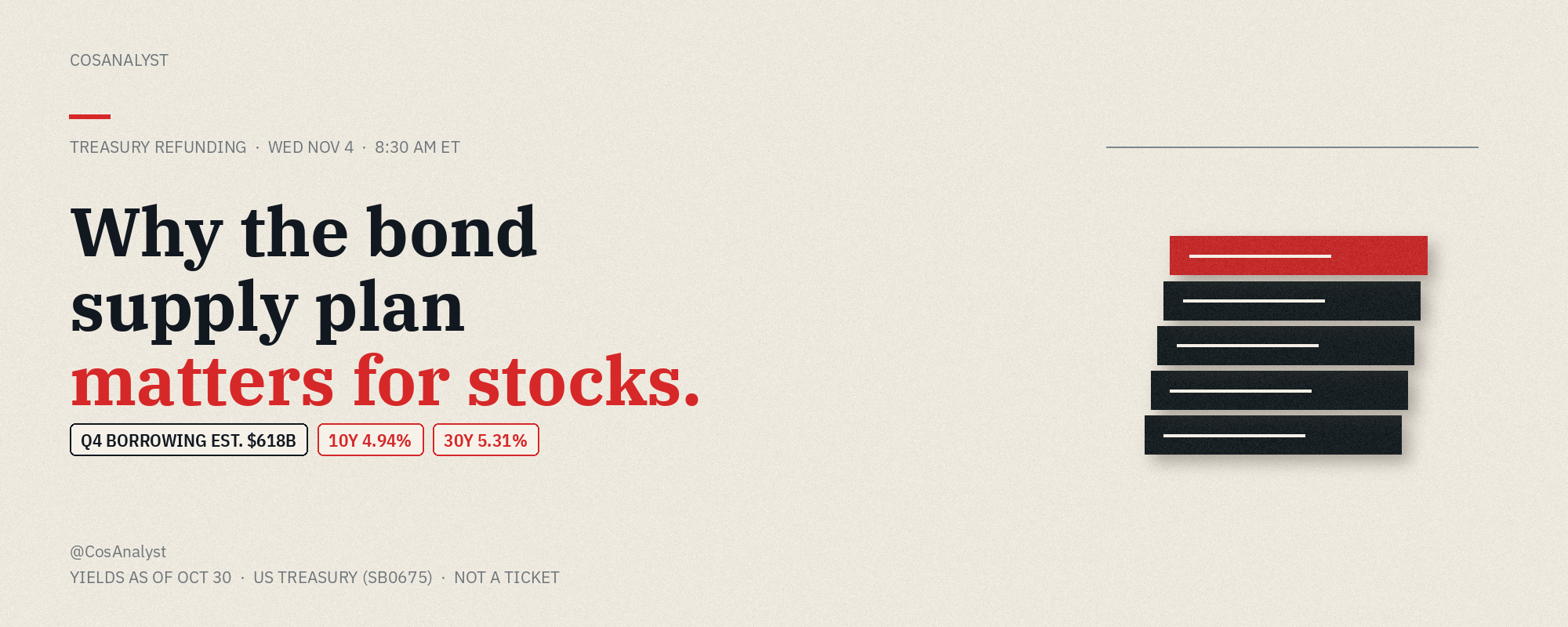
The biggest bond event of the week lands at 5:30 AM PT Wednesday, buried under election coverage. Treasury's quarterly refunding sets how much debt it sells, in which maturities, and how hard it leans on buybacks. Long yields drive stock multiples, mortgage rates and the AI capex trade, so this one matters beyond the bond desk.
What is the Treasury refunding announcement?
Four times a year, Treasury tells the market how it plans to finance the government for the coming quarter. It comes in two parts. On Monday, Nov. 2, Treasury released its borrowing estimates: $618 billion in privately held net marketable borrowing for October through December 2026, assuming an $850 billion cash balance at the end of December, and $800 billion for January through March 2027 (Treasury). The second part, the refunding statement with auction sizes, buyback plans and guidance, comes at 8:30 a.m. ET (5:30 AM PT) on Wednesday, Nov. 4, per the same release.
The $10 billion cut versus August is mostly about a bigger starting cash balance. Treasury said that excluding that cushion, the current quarter estimate is $24 billion higher than announced in August. So the underlying borrowing need went up, not down (Reuters via Investing.com).
What Treasury signaled in August
In August, Treasury said it continues to evaluate potential future changes to coupon and floating-rate auction sizes. Reuters noted that was a shift from May, when the language pointed to potential future increases. That raised speculation Treasury could eventually cut some longer-dated auctions and lean more on bills and short and intermediate coupons. Analysts cited by Reuters see the 20- and 30-year auctions as the most likely to shrink, with any increases concentrated in 2- to 7-year notes.
On Aug. 19, Treasury also at least doubled its long-end liquidity support buybacks in the 10- to 20-year and 20- to 30-year sectors, from a $2 billion maximum to at least $4 billion per operation, effective Sept. 9 through Nov. 4. It said it would give more information on future buyback sizes at this refunding (Treasury). Reuters reported the long-end maximum has been as high as $6 billion per operation.
What to watch Wednesday
- Auction sizes: any change to 10-, 20- or 30-year sizes, and whether the guidance still says Treasury is evaluating changes.
- Buybacks: whether the larger long-end buyback sizes are extended past Nov. 4, cut, or expanded, plus the updated buyback schedule.
- Forward guidance: any hint that coupon increases are coming, and in which maturities.
- Dealer questions: Treasury's dealer agenda asked about the effects of larger buybacks and about structural demand for future auction sizes (Treasury dealer agenda). The answers show up in Wednesday's documents (refunding documents).
How refunding moves yields, stocks and mortgage rates
Bonds have just rallied. The 10-year par yield fell from 5.13% on Oct. 21 to 4.94% on Oct. 30, and the 30-year was 5.31% on Oct. 30, per Treasury's daily par yield curve. The CBOE 10-year yield index was near 4.89% on Monday, Nov. 2. That rally helped stocks and housing breathe.
The risk is two-sided. Guidance pointing to more coupon supply, or smaller long-end buybacks, would push more duration onto the market and could lift the term premium, the extra yield investors want for holding long bonds. Higher long yields pressure richly valued tech and keep mortgage rates high. Long-end auction cuts or bigger buybacks would point the other way. We are not predicting which; the point is that the reaction runs through the 10- and 30-year.
Midterms and refunding: one-two punch for bonds
Election results arrive Tuesday night, and the refunding hits about eight hours later. Fiscal expectations from the vote and Treasury's supply plan land on the same bond market before the cash open. Rate expectations add pressure: on Polymarket, a 25 bp Fed hike in December was priced at 72.5% and no change at 25.5%, as of 12:51 AM PT Nov. 3 (Polymarket). See our Fed decision recap for how the Fed got here, and what higher oil means for inflation.
FAQ
What time is the Treasury refunding announcement?
Treasury releases the November 2026 quarterly refunding statement at 8:30 a.m. ET (5:30 AM PT) on Wednesday, Nov. 4, 2026. Borrowing estimates were released Monday, Nov. 2.
Will Treasury increase auction sizes?
It has not said. In August, Treasury said it continues to evaluate potential future changes to coupon and FRN auction sizes. Analysts cited by Reuters see any increases concentrated in 2- to 7-year notes, with 20- and 30-year auctions the most likely to shrink if anything changes.
How does the refunding affect stocks?
Through long-term yields. More long-dated supply or smaller buybacks can lift long yields, which pressures stock valuations and mortgage rates. Smaller long-end auctions or bigger buybacks tend to support bonds.
What are Treasury buybacks?
Treasury buys back older, less traded securities to support market liquidity and manage cash. In August 2026 it raised long-end liquidity support buybacks to at least $4 billion per operation through Nov. 4, and said it would update sizes at this refunding.
Sources and disclaimer
Disclaimer: This article is for informational and educational purposes only and is not financial advice or a recommendation to buy or sell any security. It does not predict Treasury decisions, yields or stock prices. Nothing here guarantees any outcome. Do your own research or talk to a licensed professional before making investment decisions.
Sources: US Treasury press releases sb0675 (Nov. 2, 2026) and sb0607 (Aug. 19, 2026), Treasury quarterly refunding documents page and November 2026 dealer agenda, Treasury daily par yield curve (Oct. 21 and Oct. 30), CBOE 10-year yield index via Yahoo Finance (Nov. 2), Reuters via Investing.com (Nov. 2), Polymarket (12:51 AM PT Nov. 3). Times are Pacific unless noted.
Follow @CosAnalyst on X for live market reads, and join our free Telegram channel @CosAnalystSignals.