
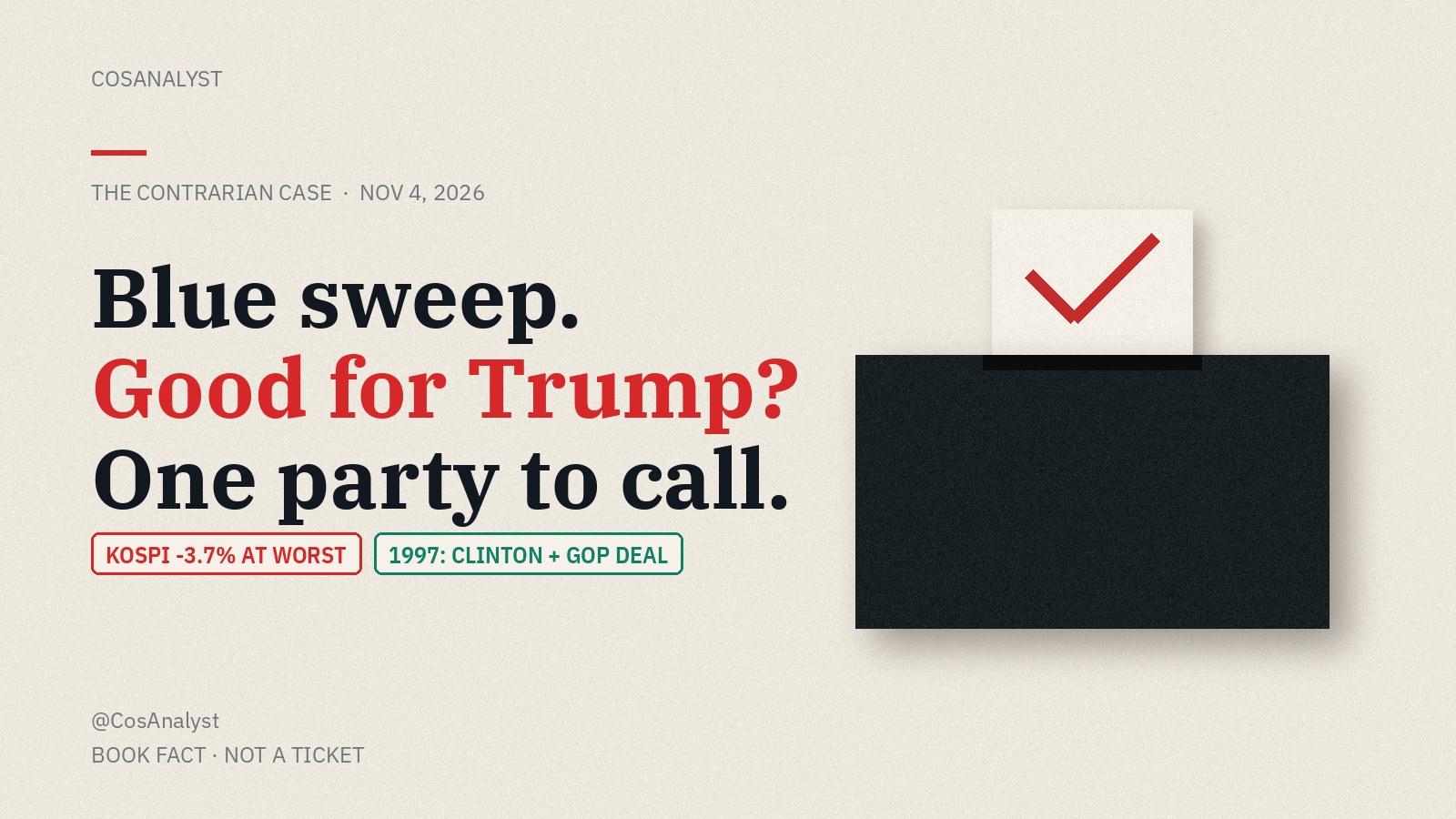
The market gave its first answer before the last polls closed. As Democrats won the House and then the Senate on Tuesday night, Nasdaq 100 futures fell about 1.9% at the 5:45 PM PT low and S&P 500 futures about 0.9% (Kobeissi). By the time Asia opened, South Korea's Kospi fell as much as 3.7% and Japan's Nikkei 225 was down about 3.6% (Bloomberg via The Straits Times).
But two days before the vote, one widely followed market voice made a bet that cuts against the selloff. Meet Kevin (@realMeetKevin) called it an unpopular opinion: a Democratic sweep could leave President Trump with more room to get things done than a split Congress would.
What Meet Kevin argued
Unpopular opinion & Iran update: A Democratic sweep gives Trump more power vs a split (obviously, R sweep is best for Trump). Next best? Dem sweep.
Meet Kevin (@realMeetKevin) on X, Nov. 1, 2026
His reasoning, in his words: "Trump will make deals with whoever is in power." A split Congress means "gridlock, shutdowns, and impossible consensus." With a fully Democratic House and Senate, "Trump only has to negotiate with ONE party," which he called "Arguably MUCH EASIER than getting R's and D's to agree." His summary: "With full D, he can negotiate. With full R, he can send $5k checks." A split, he wrote, means "Nothing happens in Congress." (Meet Kevin on X).
Where things stand tonight
- Democrats won both chambers: the House per Decision Desk HQ (6:15 PM PT), with CNN and NBC also projecting it, and the Senate per VoteHub and HuffPost on Tuesday night (our live updates).
- Trump said he is "absolutely willing to accept" the results (our live updates).
- Nasdaq 100 futures fell about 1.9% and S&P 500 futures about 0.9% at the early-evening low (Kobeissi).
- Kospi fell as much as 3.7%; Nikkei 225 was down about 3.6% (Bloomberg via The Straits Times).
The case for the take: presidents do deal with the other party
There is real history here. In 1997, Democratic President Bill Clinton and a Republican House and Senate negotiated for months and, on Aug. 5, 1997, Clinton signed the Balanced Budget Act and the Taxpayer Relief Act. The package cut spending by about $241 billion over five years and cut taxes by a net $80 billion, aiming to balance the budget by 2002 (CRS). It came after two and a half years of fiscal fights that included the 1995 shutdowns (New York Times).
Trump has done it before too. In December 2019, his administration and Speaker Nancy Pelosi's Democratic House reached a deal on the USMCA trade pact, which passed the House 385 to 41 (House Clerk). It passed less than 24 hours after that same House impeached him (New York Times).
The case against: one party can also say no as one
- A unified opposition can block as easily as it can deal. A Democratic Congress has its own agenda and little reason to hand a president wins it does not share. The USMCA deal and the impeachment came from the same Democratic House in the same week (New York Times).
- Big deals have happened under split control too. The Tax Reform Act of 1986 was a compromise between a Republican Senate and a Democratic House, signed by Reagan on Oct. 22, 1986 (Congress.gov, LA Times).
- Gridlock is not only a split-Congress problem. The 2011 debt-ceiling fight under a split Congress ended with S&P cutting the US to AA+, citing how hard it was to bridge "the gulf between the political parties" (S&P statement). The 35-day shutdown of 2018-19 began under a Republican Congress and continued after Democrats took the House on Jan. 3, 2019 (Morningstar, Wikipedia).
- The veto cuts both ways. A Democratic Congress can pass bills Trump vetoes, and overriding a veto takes two-thirds of both chambers. That math can push both sides to the table, or freeze them.
What history says about stocks and divided government
The data does not settle the debate, and it depends a lot on the time window.
| Setup (S&P 500, 1926-2023) | Years | Avg annual return |
|---|---|---|
| Unified Republican | 13 | 14.52% |
| Unified Democrat | 36 | 14.01% |
| Divided, Republican president | 34 | 7.33% |
| Divided, Democratic president | 15 | 16.63% |
Source: WT Wealth Management, citing Retirement Researcher data, 1926-2023. Past performance does not predict future results.
- In that 1926-2023 data, divided government with a Republican president, the setup Washington now has, averaged the lowest return of the four, 7.33% (WT Wealth Management).
- A different window points the other way: from 1951 through 2023, Carson Group data showed the S&P 500 averaging 9.9% under divided government versus 8% under single-party rule (CNBC).
- An Oxford study found annual excess returns averaged 10.7% under unified governments versus 0.8% under divided ones from 1927 to 2017 (Oxford).
- During the 35-day 2018-19 shutdown, the S&P 500 still rose 10.3% (Morningstar).
The honest read: party control has been a weak guide to returns compared with earnings, rates and the economy. Tonight's selloff was tied mostly to the AI and data-center trade, not to a forecast about deal-making (our live updates).
If/then for stocks
- If Trump and Democratic leaders signal early talks on spending or trade, the gridlock discount could shrink and the take gets its first test.
- If the first headlines are about investigations and vetoes instead, the market may treat this as a classic stalemate.
- If the AI and chip selloff in Asia carries into the US open, policy talk is likely to stay secondary to that trade.
Not financial advice. Historical returns are averages over long periods and do not predict what happens next. Nothing here guarantees any outcome.
Your call: Is Meet Kevin right that a Democratic Congress hands Trump an easier negotiating partner, or does it just mean two years of stalemate? Pick a side in the comments.