
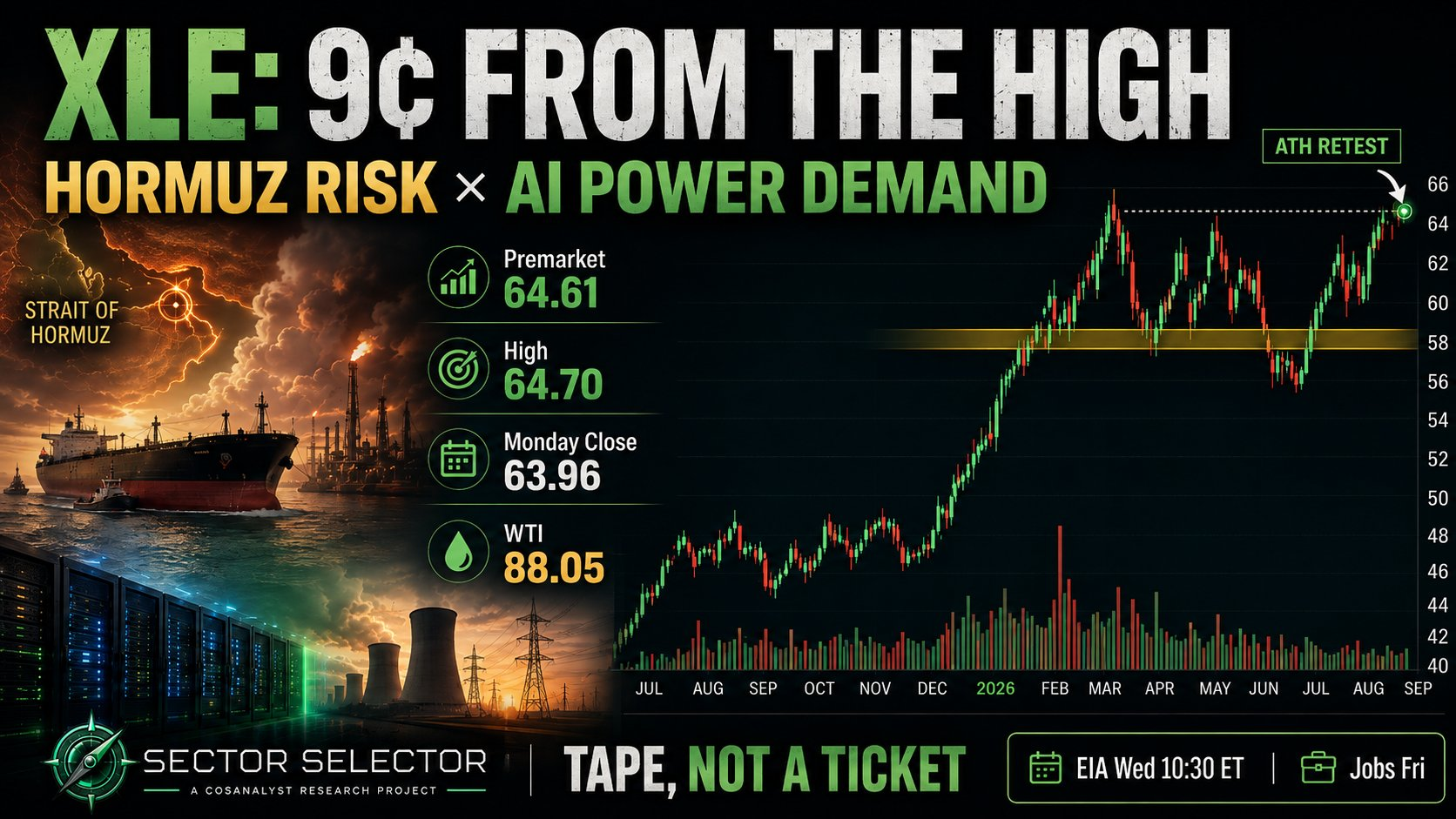
Premarket $XLE 64.61 around 3:09 PT on Tuesday, Sep 1. Nine cents under 64.70 — the high on this tape, this-month high and 52-week high on the adjusted series. Monday cash closed 63.96. Kinetic Hormuz is this morning’s lede. Data-center electricity is the bid. Two paths from here. Neither is a ticket.
The print we will say
VegasAgent TV, stamped. Oil on this desk is $WTI. We will not print a futures cashtag. 88.05 is the Tuesday morning USOIL print Cos will carry, session range 86.13–88.13. That is not a $90 $WTI breakout. See $WTI is not a ticket and Hormuz / Larak is not a $90 $WTI breakout.
64.70 is the high Cos will say for this adjusted XLE tape. It is this month’s high and the 52-week high on the ADJ series. Premarket 64.61 is nine cents under that print. Monday’s cash 63.96 is the last regular-session close. Monday’s daily low 63.14 is the first hard line under the close. SMA50 58.36 and SMA200 54.45 sit well below the collision. Those moving averages are location, not a fade.
Two launchers, then the waterway
Sunday 30 Aug, the United States struck two IRGC launchers on Larak Island that were prepping mine rockets into Hormuz. CENTCOM Capt. Tim Hawkins called it a limited, precise action against minelaying forces posing an imminent threat. First publicly reported U.S. kinetic in more than a month; the last confirmed strike was 29 July. Source: CENTCOM / Hawkins; RFE/RL, 30 Aug 2026. See Hormuz / Larak.
Jordan armed forces, via state TV and Petra, said air defense intercepted eight missiles that entered Jordanian airspace at dawn Monday. Cos does not adjudicate battle damage. Sources: Jordan army; Fox/Yingst.
UKMTO Warning 124-26, report time 2000 UTC 31 Aug 2026, from a company security officer: a tanker reported being struck by three unknown projectiles while completing an outbound transit of the Strait of Hormuz, 17 nautical miles east of Khasab, Oman. UKMTO: no casualties and no environmental impact reported. Authorities investigating. UKMTO 124-26.
CBS, wrapping Marisks, named two ships — not one flattened tanker. Saudi-flagged Sidr, run by Bahri, was reported hit first, about 17 nautical miles northeast of Khasab. Senegal Prosperity, operated by Sinokor, was reported hit about eight minutes later, east of the same coast, AIS dark after a last broadcast off Ras Tanura on Aug 30. UKMTO’s warning describes one outbound tanker and three projectiles. CBS/Marisks put two names on the water. Cos will carry both books and will not squash them into a single-ship headline. CBS live updates.
Cos does not pick a casualty number. UKMTO and CNBC print no casualties on the Monday projectile. Earlier corridor hits are a different day. We will not import a prior-day count onto this morning’s card.
The International Energy Agency’s Hormuz book is 20 million barrels a day of crude and products in 2025 — around 25 percent of world seaborne oil trade, not 20 percent. Twenty percent is a consumption-share shorthand other desks use. Cos will say seaborne. Eighty percent of those barrels are destined for Asia. Bypass pipeline capacity is 3.5 to 5.5 mb/d. IEA, Strait of Hormuz.
Collision at 64.70
The morning tape is a collision, not a conversion. Kinetic Hormuz is why oil is the lede. Multi-year electricity load is why energy is already here. A projectile east of Khasab can reprice a session. It does not invent the bid that walked $XLE to 64.70 on the adjusted book.
Monday’s cash close at 63.96 was already a +2.04 percent session before this morning’s premarket. $WTI 88.05 is Tuesday’s oil print, not a rewrite of Friday’s map and not a $90 $WTI breakout. Nine cents is the gap between premarket and the high Cos will name. That gap is tape. It is not a fill.
Hormuz is the lede. Load is the bid. 64.70 is the high on this tape. Book fact · not a ticket.
The load Cos will name
The electricity stack is a named-source trail. Cos will print the houses that published, not a blended megawatt story and not a single TWh as if the books agreed.
- LBNL 2024, United States Data Center Energy Usage Report: 176 TWh in 2023, about 4.4 percent of U.S. electricity; 325–580 TWh by 2028. LBNL 2024.
- LBNL 2025 update: 192 TWh in 2024, about 4.7 percent; 2030 reference 649 TWh, compounded range 521–843 TWh. LBNL 2025 update.
- IEA Energy and AI (2025): data-center electricity as a named global demand stack, with the United States the largest single book. IEA Energy and AI.
- EPRI Powering Intelligence 2026: 177–192 TWh in 2024; 384–793 TWh by 2030 across low/medium/high — about 60 percent above EPRI’s 2024 band. EPRI 2026.
- EIA Short-Term Energy Outlook: U.S. electricity to record highs in 2025 and 2026, with the commercial sector carrying data-center consumption. EIA STEO.
Capex is the same rule. Microsoft, Amazon, Alphabet, and Meta each print their own multi-year capital spend in filings and earnings. Cos will not add those four houses into one sum. A named 10-K line is a source. A desk-made total is a story.
The queues Cos will name
Dominion Energy Virginia, in its Feb 2, 2026 large-load queue filing with the Virginia State Corporation Commission, printed about 70,000 MW of large-load delivery-point requests. The Dominion Zone all-time peak is 24,678 MW — 24.7 GW — recorded Jan 23, 2025. The queue is nearly triple the peak. About 25 GW had assigned connection dates through 2031; about 45 GW remained under study. A queue is requested load, not energized load. Virginia Business on the SCC filing.
ERCOT, June 18, 2026: more than 438,000 MW of large-load requests, nearly 89 percent from data centers, the day PUCT approved the Batch Zero process. That is the dated print Cos will carry. A later audit or a later gigawatt is a later note. ERCOT, June 18.
Sleeves, not tickets
If the bid is multi-year electricity, the sleeves are XLE, XLU, and nuclear. Oil and gas still make the power. Utilities still interconnect the load. Nuclear still sits on the baseload side of the same stack. Those are sleeves on a tape. They are not Cos tickets, not a Sector Selector auto-rotate, and not a paper blotter.
We will not convert 64.70 into an Energy buy. We will not convert a Dominion queue into a utility buy. We will not convert a nuclear renaissance headline into a name. A sleeve is how you read the collision. A ticket is a different desk.
Two paths
Path one: $XLE accepts 64.70 on this tape. That confirms the high Cos will name. It is not a fill and not an invitation to chase nine cents.
Path two: $XLE gives back Monday’s cash 63.96, then the Monday daily low 63.14. That is the invalidation stack. 63.96 first. 63.14 next. A failed hold under the close is not a short ticket either.
Two paths. Neither is a ticket. Skip is valid.
This week’s test
- Tue 9:05 ET — Barr (not Warsh) · 10:00 JOLTS + ISM manufacturing
- Wed 8:15 ET — ADP · 10:30 EIA ($WTI) · 2:00 Beige Book
- Thu 8:30 ET — claims + Waller · 10:00 ISM Services
- Fri 8:30 ET — August jobs — the print
Tuesday is Barr, JOLTS, and ISM. It is not Warsh. Wednesday 10:30 ET is EIA — the oil inventory card on this week’s test. Friday is August jobs. Hidden risk on the Aug 31 desk note was duration + $WTI + jobs. A Tuesday premarket at 64.61 does not retire that sentence. See No Warsh Tuesday.
64.61 is nine cents under 64.70. Hormuz is kinetic. The load is multi-year. Two paths. Book fact · not a ticket.
Prior notes on this collision: Hormuz / Larak is not a $90 $WTI breakout · $WTI 86.17 is tape. A Tuesday card on X carried the same 64.61 / 64.70 / 88.05 print: status 2094735026697146863.
Friday 28 Aug map, for the footnote only: XLE 87 CONFIRMED HOLD #3. XLV 95 LEADER. NO TRADE. We do not auto-rotate Energy because $XLE tagged 64.61 or because $WTI printed 88.05. Re-rank Energy relative strength Friday if oil sticks. That ranking lives on the research project, not on this homepage.