
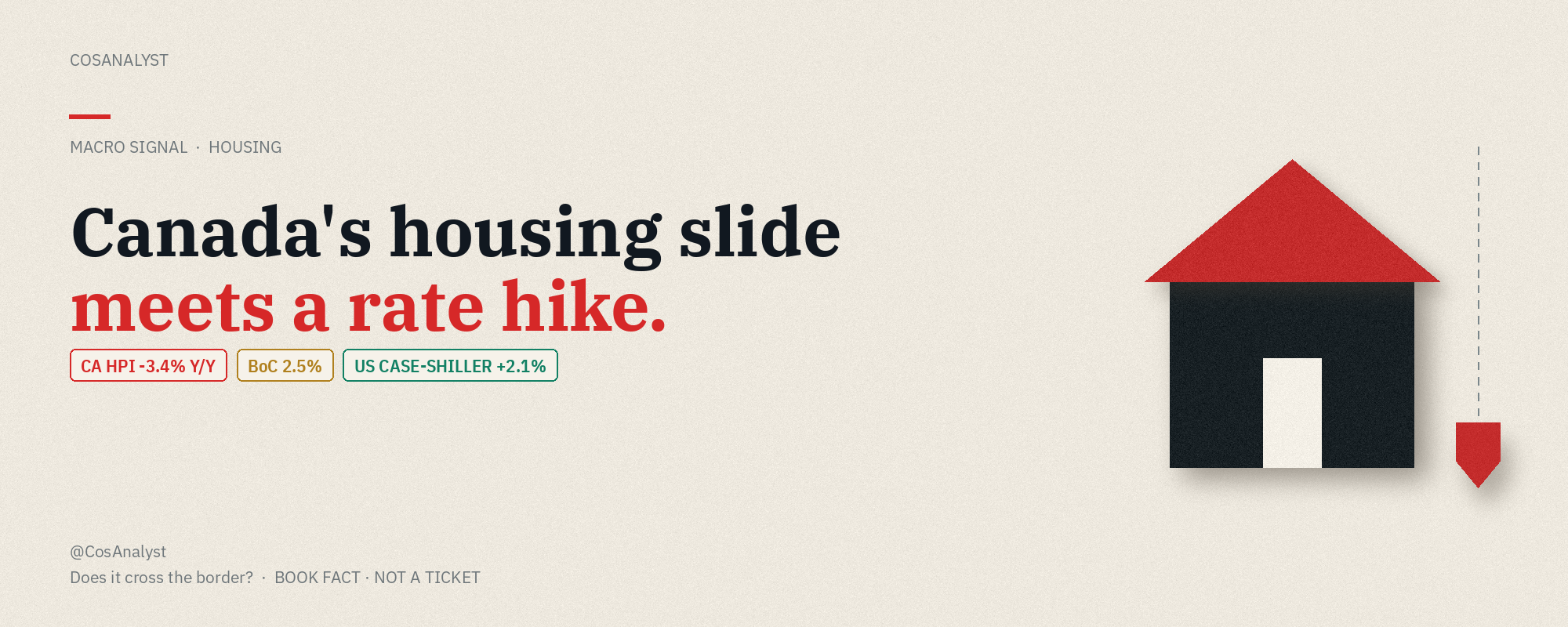
Canadian home prices are falling, and the Bank of Canada just raised rates. US home prices are still edging up in nominal terms. The question is whether Canada's slide crosses the border. Some of it can, through a few specific channels. But the bigger force on both markets is the same one: energy-driven inflation keeping rates high.
Is the Canadian housing market crashing?
Not by the data so far. It is a step back, not a collapse. In September, Canadian home sales fell 2.3% from August and were 7.7% below a year earlier, per the Canadian Real Estate Association (CREA). The MLS Home Price Index was down 3.4% year over year, the first time since January that the annual decline got bigger. The national average price was $666,538 CAD, down 1.6%. The sales-to-new-listings ratio was 48.8%, which is balanced-market territory, with 4.9 months of inventory. CREA cut its 2026 sales forecast to 444,530 units, down 5.2% from 2025 (via Burnaby House).
| Market | Latest data | Source |
|---|---|---|
| Toronto (GTA), September | 5,040 sales (-9% y/y); benchmark -4.7%; avg $1,006,409 (-5.1%) | TRREB |
| Toronto (GTA), October | Sales -7% y/y; condo avg price -6% | Move Smartly, Nov 2 |
| Vancouver, September | 1,717 sales (-8.4% y/y); benchmark $1,075,900 (-5.5%) | Greater Vancouver REALTORS |
| Vancouver, October | 2,002 sales (-10.5% y/y) | Zealty MLS feed |
Prices in CAD.
Why Canadian home prices are falling
Rates. On Oct. 28 the Bank of Canada raised its overnight rate 25 bp to 2.5% and said "there could be a need to increase the policy rate further," citing the risk that high energy prices spread into broader inflation (Bank of Canada). Big banks raised prime to 4.70% (CBC), so variable-rate payments rise right away. Canadian mortgages reset faster than US loans because fixed terms are shorter, so Canada feels rate shocks first. CREA's economist had already warned that rising fixed mortgage rates "will likely send some buyers back to the sidelines."
Could Canada's housing slide spread to the US?
Canadian buyers: real, but small and local. Canadians were again the top foreign buyer group in NAR's survey covering April 2025 to March 2026, at 16% of international purchases, about 10,700 homes worth $5.2 billion. But all foreign buyers together were only 1.7% of US existing-home sales (Realtor.com). Any pullback would show up in Florida, Arizona and border-state second-home markets, not the national numbers.
Rates: the real link, and it mostly runs the other way. Canada's hike was driven by energy inflation. The same energy shock is pushing on US inflation (see why oil is up today). Canada is not dragging US housing down. Both are reacting to the same pressure. Long US yields, which drive mortgage rates, also face a test at Wednesday's Treasury refunding announcement.
Banks and sentiment: tail risks to monitor. Canada's big banks have meaningful US operations, and weaker Canadian housing means less Canadian consumer spending. We have no reported data showing a lending pullback now.
Will the US housing market crash in 2026 or 2027?
We do not forecast crashes, and the sourced data does not show one. The S&P Cotality Case-Shiller national index was up 2.1% year over year in August but down 0.2% month over month before seasonal adjustment; with inflation at 3.4%, real prices fell for a 15th straight month (S&P Dow Jones Indices). NAR reported September existing-home sales at a 3.99 million annual pace, down 2.2% year over year, with a $417,500 median price (+1.3%) and 4.8 months of supply (NAR). That is a volume freeze, not a price collapse. Most US owners hold 30-year fixed loans, which cushions them from rate hikes in a way Canadian owners are not.
What to watch: BoC December, US mortgage rates, CREA next release
- Bank of Canada in December: another hike would test whether the national -3.4% decline widens.
- US mortgage rates and the 10-year yield: the main channel to US housing. Fed odds matter here; on Polymarket a 25 bp December hike was at 72.5%, as of 12:51 AM PT Nov 3 (Polymarket).
- CREA October data, expected mid-November.
- Florida and Arizona winter demand for any sign Canadian buyers are pulling back.
FAQ
Is the Canadian housing market crashing?
Not by current data. CREA's September 2026 numbers show prices down 3.4% year over year and sales down 7.7%, with a balanced sales-to-new-listings ratio of 48.8%. That is a decline, not a collapse.
Why are Canadian home prices dropping?
Mainly higher borrowing costs. Fixed mortgage rates rose and the Bank of Canada hiked 25 bp to 2.5% on Oct. 28, 2026, warning more hikes could follow because of energy-driven inflation.
Will the US housing market crash in 2027?
No one can know that. Current data shows US prices up 2.1% year over year in August (Case-Shiller) with sales near multi-year lows. The bigger risk is high mortgage rates extending the sales freeze.
How do rising bond yields affect home prices?
Mortgage rates track long-term bond yields. Higher yields raise monthly payments, which shrinks the pool of qualified buyers and puts pressure on sales and, over time, on prices.
Sources and disclaimer
Disclaimer: This article is for informational and educational purposes only and is not financial advice or a recommendation to buy or sell any security. Data comes from the public sources listed and may be revised. It does not predict home prices. Nothing here guarantees any outcome. Do your own research or talk to a licensed professional before making investment decisions.
Sources: CREA (Sept. 2026 release, Oct. 16; October forecast), TRREB Market Watch (Sept. 2026), Move Smartly (Nov. 2), Greater Vancouver REALTORS, Zealty, Bank of Canada (Oct. 28), CBC, S&P Cotality Case-Shiller (Oct. 27), NAR (Oct. 13; 2026 international transactions via Realtor.com), Polymarket (12:51 AM PT Nov. 3).
Follow @CosAnalyst on X for live market reads, and join our free Telegram channel @CosAnalystSignals.