
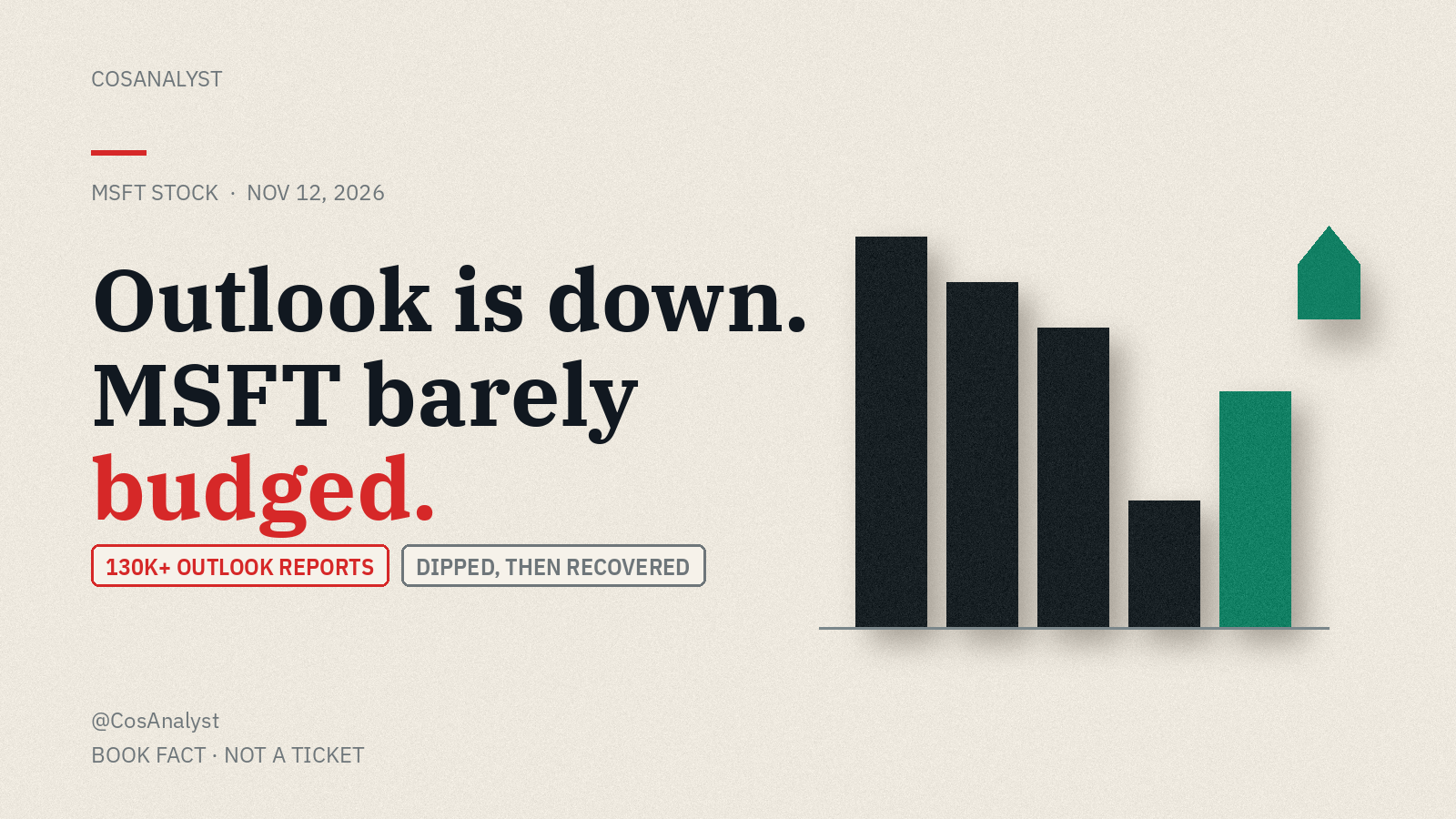
UPDATE Nov 13, 4:15 AM PT: Outage passes 12 hours, hits 74 countries. The Microsoft outage that started around 8:17 AM PT (16:17 UTC) on Thursday, Nov 12, ran past 12 hours, and searches for microsoft.com down tracked the same failure. Crypto Briefing reported user complaints from 74 countries and territories. Downdetector logged a US peak of more than 130,000 Outlook complaints.
Outlook, Teams, Copilot, SharePoint Online, and OneDrive were affected through Exchange Online. Microsoft says it is not a cyberattack: unexpectedly unavailable servers pushed load onto the remaining infrastructure, and some servers stopped responding again when traffic returned, so the first fixes did not hold (The Asian Banker).
Banks and governments felt it. In Malaysia, Maybank, CIMB, RHB, and others warned of email delays and pushed customers to phone and app channels (The Star). Banks in India gave the same warning (Fortune India). Reuters reported a Taiwanese financial firm canceled a scheduled bond repurchase transaction. Courts and visa processing slowed in several countries (Crypto Briefing).
Early Friday, Microsoft said it was seeing encouraging recovery progress in Europe, with Japan comparatively more stable and North America improving (The Guardian).
The stock question for Friday is whether a 12-hour, multi-country outage changes the story for enterprise cloud reliability, or stays a headline like past outages. Watch MSFT in pre-market, and whether Microsoft offers customer credits.
This morning, the Cos desk called ADP payroll support and was told they were down because Microsoft was down. That is how a cloud outage shows up in real life: not as a status-page code, but as a payroll desk that cannot help you, an inbox that will not open, and a Teams chat that goes nowhere.
By midday PT, it was still a mess. Outlook and Exchange Online, Teams, OneDrive, SharePoint, Microsoft 365 Copilot, and Defender XDR were all caught in it. Microsoft logged the incident as EX1550543 (with a related Microsoft 365 incident, MO1550821), said a large number of servers had become "unexpectedly unavailable," and paused deployments. Downdetector logged more than 130,000 Outlook reports around 1 p.m. ET, according to AP, Fox Business, and Euronews.
Microsoft stock barely cared. As of about 12:40 PM PT, MSFT was at $521.77, up 0.12% on the day, while QQQ was down 0.46% and SPY was down 0.36%, per TradingView (Cboe One, live). There was a dip. Traders who only look at the daily change will miss it.
The facts in one table
| Item | What happened | Why it matters |
|---|---|---|
| The outage | Outlook/Exchange Online, Teams, SharePoint, OneDrive, Copilot, and Defender XDR hit, first in the Americas, then potentially in any region | This was not a single-app glitch. It cut across email, chat, files, AI, and security. |
| Official cause so far | Microsoft said elevated load came from a large number of servers becoming unexpectedly unavailable, not a surge in traffic. It later said affected servers were failing automated health checks and showed elevated processor usage. | That is an internal infrastructure problem, still under investigation, not a finished root-cause report. |
| Incident IDs | EX1550543 and MO1550821 | Admins can track those in Microsoft 365 service health, or on the public status page if the admin center will not load. |
| User reports | More than 130,000 Outlook reports on Downdetector around 1 p.m. ET, per AP, Fox Business, and Euronews. Euronews also cited more than 46,000 Microsoft 365 reports and about 3,000 for Teams. | Downdetector counts reports, not a census of every person affected. |
| Status at midday | Microsoft's public status page still listed Microsoft 365 Business/Enterprise as service degradation. It showed no Azure issues at that time. | The incident was not closed as of about 12:40 PM PT. Azure looking clean matters for how the stock is likely to be priced. |
| MSFT tape | Opened $521.10, ran to a high of $529.66 around 8:10 AM PT, then sold off to a low of $520.10 around 10:45 AM PT (about 1.8% from the high). Last $521.77, up 0.12%. | The market flinched when Outlook reports exploded, then bought the dip. |
| Vs the market | QQQ down 0.46%, SPY down 0.36% at the same stamp | MSFT was slightly green while the Nasdaq 100 and S&P 500 were red. |
Sources: Microsoft 365 Status updates and Microsoft's public service health page; AP, Fox Business, Euronews, TechCrunch, Wired, Windows Central; TradingView 5-minute and daily bars, as of about 12:40 PM PT Nov 12, 2026. Intraday levels move.
What actually happened, and what did not
Wired's timeline is the cleanest public clock we have. Around 10:40 a.m. ET (7:40 AM PT), Microsoft said it was investigating Teams issues in North America. Just before 1 p.m. ET (10 AM PT), it said it was aware of problems accessing Exchange Online mailboxes through multiple connection methods in the Americas, including Outlook on the web, MAPI, Exchange ActiveSync, and the REST API (Wired). The company later said Microsoft 365 connectivity could be affected in any region (TechCrunch).
Microsoft's own explanation shifted from "elevated load" to a more specific point: the load was not coming from more user traffic. A large number of servers had dropped out, which piled work onto the machines that were still up. Engineers paused deployments and configuration changes, started moving traffic off the affected infrastructure, and restarted affected servers. Later updates said those servers were failing automated health checks, possibly tied to a component that processes those checks, and that Microsoft was testing a targeted bypass while also looking into elevated processor usage.
Two claims floating around this morning should be handled carefully.
First, a cyberattack. Wired reported there is currently no indication that a cyberattack caused the outage. Microsoft has not published a final cause, but everything it has said so far points to its own servers failing health checks, not to an intrusion. That could change. It has not been shown.
Second, a broader internet event. Windows Central noted user reports involving Google, AWS, Cloudflare, and Steam, and said Azure also appeared affected. Fox Business said Downdetector also showed issues with Xbox and Amazon, but it was not immediately clear how widespread those were. Microsoft's public status page, checked around 12:40 PM PT, said no Azure issues were detected. Until a shared root cause is confirmed, treat those other-cloud reports as unconfirmed noise, not as proof that this was a multi-cloud failure.
The tape did flinch, then it faded
If you only glance at the daily change, MSFT looks almost unchanged, up 0.12%. The 5-minute chart is more honest.
The stock opened at $521.10, just under Wednesday's close of $521.13, and climbed to $529.66 around 8:10 AM PT, while the early Teams reports were already out but before the Outlook wave hit. Around 10:00 AM PT, as Exchange Online problems and Downdetector reports spiked, MSFT was still near $528.62. Over the next 45 minutes it sold off, printing a session low of $520.10 at 10:45 AM PT, about 1.8% below the morning high and about 1.6% below that 10:00 AM PT level. In the same window, QQQ and SPY each slipped only about 0.2%. This was a Microsoft-specific dip, not just the market rolling over.
Then buyers showed up. By 12:40 PM PT, the stock was back to $521.77, slightly above Wednesday's close, even as QQQ and SPY stayed modestly red. That is the trader tell: a real scare, a fast fade, and relative strength into midday.
This is not Microsoft's first ugly outage
Today follows a multi-day Microsoft 365 outage that began Aug 31, 2026. Microsoft blamed a "core authentication configuration" issue (TechCrunch), and BleepingComputer reported the incident was mitigated on Sept 3.
The stock path during that window is useful, with a caveat: other market factors may have been in the tape, so this is a coincidence in time, not a controlled experiment. MSFT closed at $513.53 on Friday, Aug 28, then $507.29 on Monday, Aug 31, down 1.2%. It kept sliding to $496.82 on Sept 2, about 3.3% below that Friday close, then bounced 2.7% to $510.12 on Sept 3, the day the outage was reported as mitigated. The bigger damage, if you want to tie any of it to reliability worries, showed up over several sessions, not in a single morning.
The other comparison traders reach for is July 19, 2024, the CrowdStrike Falcon update that knocked out Windows machines worldwide. On that day, MSFT closed at $437.11, down 0.74% from the prior close of $440.37, after printing a low of $432.00, about 1.9% below the prior close, per TradingView daily bars. Even the most famous Windows outage in years did not produce a collapse in Microsoft's stock. Today's midday read is milder still: a sharp dip that has already been bought, and a stock that is slightly higher while the rest of the tape is slightly lower.
Why a huge outage barely moves a nearly $3.9 trillion stock
Microsoft's market cap was about $3.88 trillion at the midday quote. A few hours of Outlook and Teams downtime is painful for customers. It is rarely large enough, on its own, to change the cash-flow story investors usually price in a company that size.
Switching costs work in Microsoft's favor here. Enterprises do not rip out Outlook, Teams, and SharePoint after one bad morning, or even after a multi-day outage, without a long, expensive migration. We have not seen confirmed, named enterprise defections tied to the September incident, and today's outage is too fresh for a churn read.
The part of the Microsoft story the market has actually been fighting about is Azure and AI infrastructure spending, not whether email loaded before lunch. Official status showed no Azure issues at midday. If that holds, this stays an M365 reliability event, not a cloud-capacity event.
Service credits are also a much smaller number than the lost workday. Microsoft's Online Services SLA typically starts crediting core services such as Exchange Online if monthly uptime falls below 99.9%, beginning at 25% of the affected service's monthly fee. Those credits are the contractual remedy. They do not repay companies for idle payroll. Whether today's incident even qualifies depends on duration, which users were affected, and how Microsoft measures downtime, which is not settled while the incident is still open.
None of that means reliability is free. A second major Microsoft 365 outage in roughly three months is a real operational mark. It just is not, so far, a reason the stock is being repriced today.
If/then: levels to watch
- If MSFT holds Wednesday's close near $521.13 and today's $520 area through the close, the market is treating this as a faded ops scare, not a franchise problem.
- If it loses $520 and stays there into the close or Friday, the September reliability overhang may be back in the tape.
- If it reclaims and holds the morning high near $529.66, the dip is fully faded.
- If Microsoft has not restored service by the close, or a later review points to a broader platform issue, watch for a second-day reaction. In September, the larger slide accumulated over several sessions, not just day one.
- If Azure remains clean on official status and this stays an Exchange/M365 problem, it is less likely to be priced as an AI-infrastructure event.
Not financial advice. This is a developing story, the outage was still listed as service degradation at midday, and prices can change through the close. Nothing here guarantees any market outcome.
Follow @CosAnalyst on X, like the CosAnalyst Facebook Page for plain-English market notes, and join our Telegram at @CosAnalystSignals.
Your call: Should investors treat today's Microsoft 365 outage as a one-day mess the stock already faded, or as another warning that reliability risk is building after September's multi-day outage? Pick a side in the comments.