
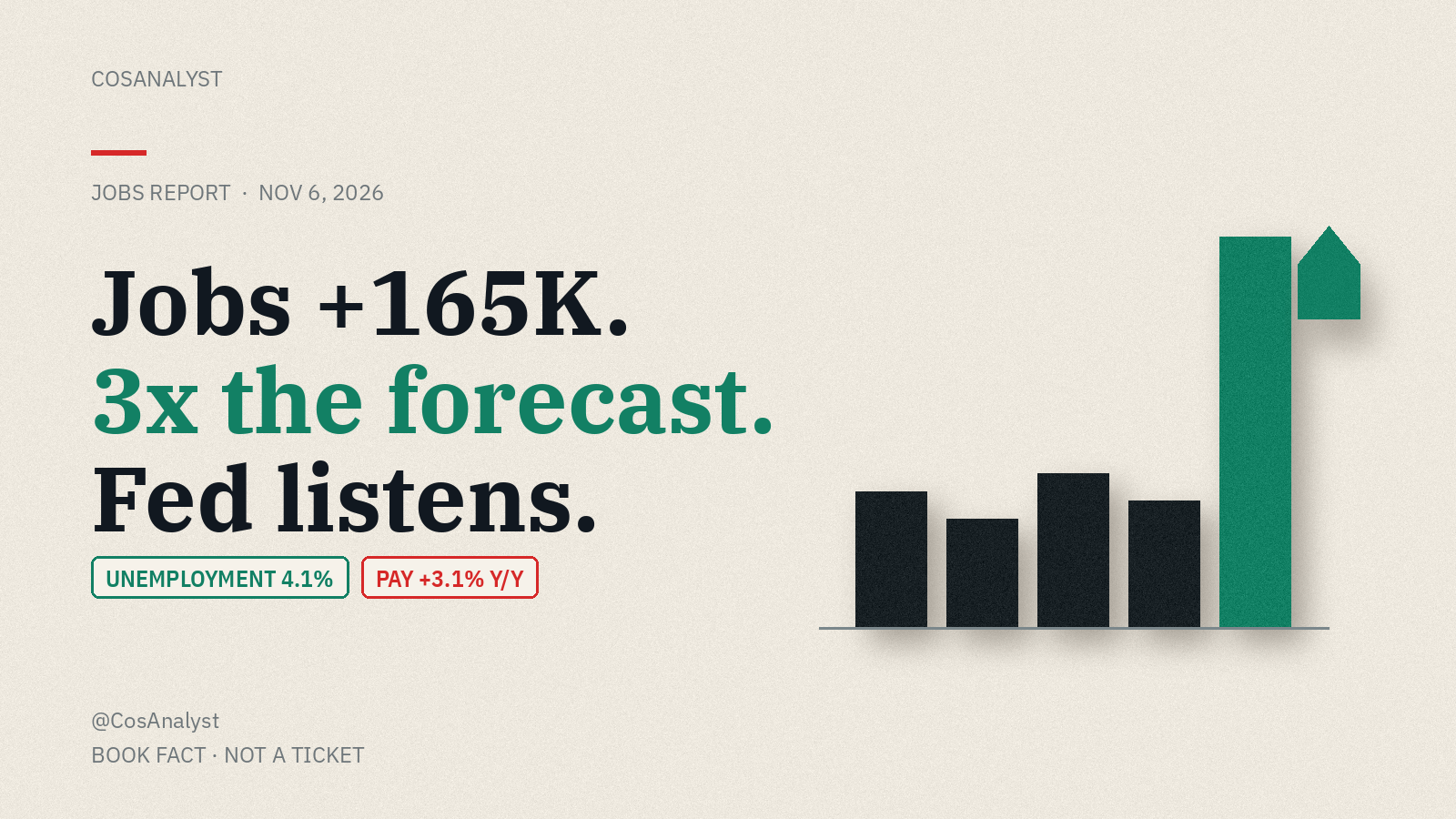
Think of the monthly jobs report as the economy's pulse check. This morning the pulse came back strong. U.S. employers added 165,000 jobs in October, roughly three times the 59,000 to 65,000 Wall Street expected, and unemployment ticked down to 4.1% from 4.2% (BLS, CNBC).
That sounds like pure good news. For the stock market it is more complicated, and the reason comes down to one word: the Fed.
The numbers in one table
| Item | October 2026 | Why it matters |
|---|---|---|
| Jobs added | +165,000 | Prior 12-month average was about +48,000 |
| Unemployment rate | 4.1% | Down from 4.2%; stuck in a 4.1% to 4.3% range since March |
| Average hourly pay | $38.00, +0.4% m/m | +3.1% from a year ago |
| Workweek | 34.4 hours | Unchanged |
| Aug + Sep revisions | +84,000 combined | Earlier months were stronger than first reported |
| Part-time, want full-time | 4.8 million | Up 339,000 in one month |
Source: BLS Employment Situation, October 2026.
Why good jobs news can be tricky for stocks
Here is the chain reaction. More people working means more paychecks. More paychecks means more spending. More spending can keep prices rising. And the Fed's main job right now is keeping prices in check. When hiring runs hot, the Fed has less reason to relax and more reason to keep rates high, or even raise them.
Higher rates are like gravity for stocks. They make borrowing more expensive for companies, and they make safe bonds look more attractive next to riskier shares. So a strong jobs number can be good for the economy and still make traders nervous about the Fed.
That is exactly the debate today. After the report, traders raised their bets that the Fed hikes rates by a quarter point in December. We track those odds live in our December Fed odds hub.
Where the hiring actually happened
- Professional and business services: +70,000, versus a 12-month average of about +15,000. This is the office-job engine, and it woke up.
- Health care: +42,000. The steady hirer that keeps showing up every month.
- Transportation and warehousing: +25,000. Goods are moving.
- Manufacturing: +19,000. A sector that had been quiet added workers.
Breadth matters. When hiring spreads across offices, hospitals, trucks, and factories, it is harder to call the number a fluke.
The fine print that cuts the other way
Not everything in the report was strong. The number of people working part-time who want full-time work jumped 339,000 to 4.8 million. About 2.0 million people have been out of work for six months or longer, 27.6% of everyone unemployed. The labor force participation rate sits at 61.9%. In plain terms: plenty of hiring at the top line, but some workers are still getting fewer hours than they want.
Pay growth is the other piece the Fed watches closely. Average hourly earnings rose 0.4% in the month to $38.00, and 3.1% over the year. That is a healthy raise for workers, and not the kind of runaway wage spike that forces a central bank's hand on its own.
How this lands after Thursday's selloff
Timing is everything. The report landed one day after the Nasdaq's worst session since April 2025, when AI and data-center regulation fears hit tech hard (our morning recap). Stock futures were mixed after the print: Dow futures softer, Nasdaq futures trying to bounce.
So the market is juggling two stories at once. The jobs report says the economy is not cracking, which is a relief for anyone worried about a recession. But it also says the Fed has room to stay tough, which is a headwind for the high-priced tech names that just got hit.
If/then: what to watch next
- If December hike odds keep climbing into next week, expect rate-sensitive stocks like tech and small caps to feel pressure even if AI fears cool.
- If the next inflation reading comes in soft, a strong job market starts to look like the best of both worlds: growth without a price problem.
- If involuntary part-time work keeps rising, the headline strength may be thinner than it looks, and the Fed could get more cautious.
- If Nasdaq holds its bounce through the close, traders are treating the jobs beat as economic good news rather than Fed bad news.
Not financial advice. Market reactions change through the day. Nothing here guarantees any outcome.
Follow @CosAnalyst on X, like the CosAnalyst Facebook Page for plain-English market notes, and join our Telegram at @CosAnalystSignals.
Your call: Is a hot jobs report good news for stocks because the economy is strong, or bad news because it gives the Fed a reason to hike in December? Pick a side in the comments.