
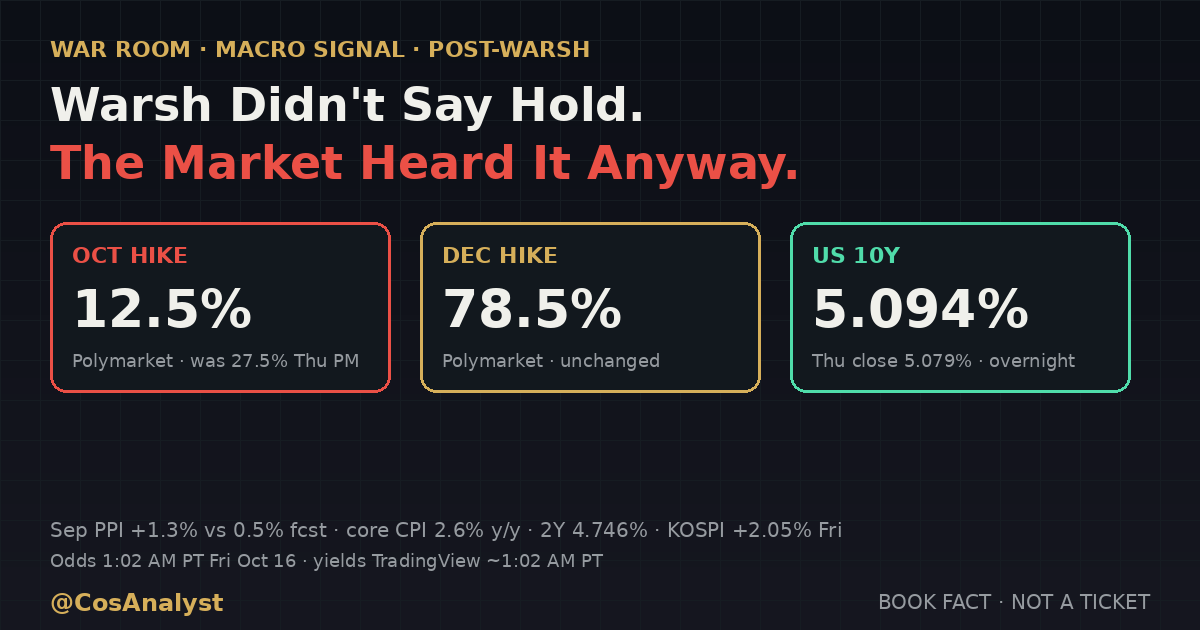
This was the week inflation was supposed to force the Fed's hand. September core CPI rose 0.3% on the month and 2.6% on the year, a tenth above consensus. Headline CPI ran at 3.7%. Then producer prices jumped 1.3% in September against a 0.5% forecast. That was the biggest monthly gain since March 2022, according to BLS. Core PPI rose 0.7% against 0.3% expected.
Thursday night, Fed Chair Kevin Warsh sat down for a fireside chat at the IMF and World Bank Annual Meetings. He did not say the Fed would hold in October. Nick Timiraos of the Wall Street Journal reported that Warsh did not want to give any hints on the October meeting. FinancialJuice reported he is "skeptical about predicting actions in meetings for rest of 2026."
The market heard a hold anyway. On Polymarket, the odds of a 25 basis point hike at the Oct 27-28 meeting were 27.5% at 1:49 PM PT Thursday. At 1:02 AM PT Friday they were 12.5%. That is a cut of more than half in about 11 hours, with no new US data in between. The December hike contract did not move. It sat at 78.5% both times.
Here is the disagreement. The inflation data says the Fed is behind. The chair's tone said he is in no hurry to prove it. The market split the difference. It pushed the hike out two months and kept it.
What Warsh actually said
He spent most of the hour on the global economy. The wire headlines:
- Inflation is a widespread global issue, not exclusive to the United States (FirstSquawk).
- Coordinated monetary tightening across much of the world means no economy can escape the impact (FirstSquawk).
- The world economy has been more resilient than he would have predicted five months earlier (FirstSquawk). Reuters said he voiced optimism about US strength and surprise at how well global economies have been "hanging in there."
- The AI "massive investment surge" "isn't by accident" but the result of "good policy," and the AI boom is "probably the most important thing happening in the global economy on the upside" (Timiraos, WSJ).
- The Fed needs to evaluate financial stability risks and ask whether there are downside tail risks policymakers can do something about (FirstSquawk, LiveSquawk).
Read those together and the hawkish sentence never shows up. A chair who wanted to lock in an October hike after the hottest PPI since 2022 had an easy opening. He talked instead about tightening that is already happening around the world, and about tail risks. Traders took that as patience. Overnight, LiveSquawk carried a Financial Times headline that said the same thing: bets on a Fed hold in October strengthened after Warsh's comments.
Why it matters
The October meeting is 11 days away. Under the Fed's standard blackout rule, which starts the second Saturday before a meeting, policymakers go quiet after this weekend. Thursday night was close to the last word from the top before the vote. If Warsh wanted to pre-sell a hike, this was the window. He let it pass.
The market is still pricing a hike this year. December at 78.5% says so. What changed is timing. Timing is what the 2-year yield, the dollar and every rate-sensitive trade price off.
Five stress signals
- 1. PPI ran +1.3% against a 0.5% forecast. That is the biggest monthly gain since March 2022, and 6.3% year over year (BLS). A Fed that wanted a reason to move in October already has one. Warsh did not reach for it.
- 2. October hike odds are now below where they started the week. About 18% before CPI on Wednesday. 46.5% on Wednesday morning. 27.5% on Thursday afternoon. 12.5% at 1:02 AM PT Friday (Polymarket). Two hot inflation reports, and the October hike is less likely than before either one.
- 3. December did not budge. A 25 bp December hike sits at 78.5%, no change at 18.5%, and a 50 bp move at 3.25% (Polymarket, 1:02 AM PT). The market moved the hike to December and kept it.
- 4. The 2-year gave back the spike. It traded near 4.746% overnight. Wednesday it hit 4.95% intraday and closed near 4.806%. That is about 20 basis points off the high, in the maturity most tied to Fed policy.
- 5. The 10-year did not follow. It traded near 5.094% overnight, up from 5.079% at Thursday's close and still above 5%. The gap between the 10-year and the 2-year widened to about 35 basis points from about 32 at Thursday's close. One read: a patient Fed now means more inflation risk later, and long bonds want to be paid for it.
What the tape did overnight
Risk took the relief. South Korea's KOSPI closed Friday up 2.05% at 5,668.05, after touching 5,809.94. That came one day after its 7.57% circuit-breaker drop. Japan's Nikkei closed up 1.39% at 65,324.07. S&P 500 futures traded near 7,804.5, up 0.17%. Nasdaq 100 futures were near 30,179, up 0.12%.
The rest of the board was quiet. The dollar index slipped 0.19% to about 101.81. Gold rose 0.27% to about $4,182. $WTI traded near $95.74, down about 2.3% on the session. The VIX printed 16.04 at 1:00 AM PT, under Thursday's 16.46 close.
That reads as a market that stopped bracing for an October surprise. Calm, with no euphoria in it.
The catch
Warsh's resilience line cuts both ways. An economy that has held up better than he expected five months ago is one that can absorb another hike. His point that inflation is global also means the US cannot wait for imported prices to cool on their own. The market chose the dovish half of each sentence. December at 78.5% is the reminder that it heard the other half too.
How to prepare
- 1. If September import prices (5:30 AM PT, forecast +0.8% m/m, prior +0.7%) come in hot, then watch whether October odds climb back toward Thursday's 27.5%. If they hold near 12.5%, the market is trusting Warsh's tone over the data.
- 2. If the 2-year pushes back above 4.81%, Wednesday's close, then the front end is rejecting the patient read. Staying under 4.75% keeps it alive.
- 3. If the 10-year holds above 5% while the 2-year slides, then the curve is pricing later inflation risk. Long bonds stay the weak spot even on friendly Fed news.
- 4. If industrial production (6:15 AM PT, forecast +0.4%, prior 0.0%) beats, then it fits Warsh's resilience line. That supports a December hike more than it revives October.
- 5. If December slips under 70%, then the story changes from "later" to "maybe not at all." Watch December more closely than October from here.
Takeaway
Hot CPI. The hottest PPI since 2022. A Fed chair who said nothing hawkish and refused to hint. The market cut October hike odds from 27.5% to 12.5% and left December at 78.5%. It heard a hold Warsh never said. The 10-year above 5% is the part that has not bought in. If today's data and the 2-year back the patient read, October is a hold and December becomes the meeting that matters. If they don't, this week's 46.5% spike can come back fast.
If you want our free research notes as they land, join the Cos Analyst Signals channel on Telegram: https://t.me/CosAnalystSignals. It is free, and nothing there is financial advice.
BOOK FACT · NOT A TICKET. CosAnalyst research. Not financial advice. Polymarket October and December Fed decision odds via Polymarket gamma API as of about 1:02 AM PT, Fri Oct 16, 2026 (compared with 1:49 PM PT Thu Oct 15 and this week's logged path). Yields, futures, $WTI, DXY, gold and VIX are TradingView marks as of about 1:00 to 1:02 AM PT, Fri Oct 16, 2026. KOSPI and Nikkei are Friday Oct 16, 2026 session closes via TradingView. Thursday closes (10Y, 2Y, VIX) via TradingView. September CPI and PPI from BLS. Calendar times and forecasts from the TradingView economic calendar. Warsh remarks as reported on X by Nick Timiraos (WSJ), FirstSquawk, FinancialJuice, LiveSquawk (citing the Financial Times) and Reuters, Thu Oct 15 8:51 PM PT to Fri Oct 16 12:02 AM PT. Third-party figures and quotes are credited to their sources.