
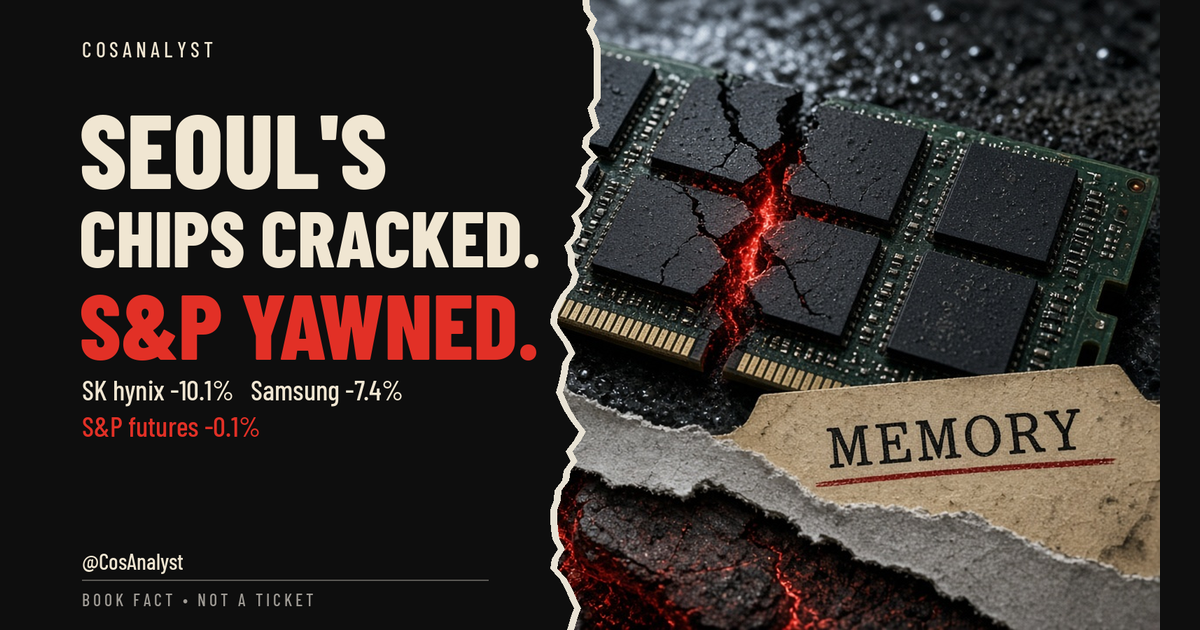
At 3:30 in the afternoon in Seoul, while most of America was asleep, the two biggest memory-chip makers on earth finished a brutal session. SK hynix closed down 10.1%. Samsung Electronics closed down 7.4%. South Korea's KOSPI fell 5.5% to 6,035.35. By the time New York woke up, S&P 500 futures were down a tenth of a percent.
That gap is the story. One market just took a punch to the chin. The other barely noticed. This piece argues the market is filing Tuesday under "Korea" when it belongs under "chips," and chips have been the engine of this entire bull run.
What happened overnight
The trigger was a pair of headlines that hit the same nerve. Reports that China is adding memory-chip capacity landed alongside fresh doubts about how long the AI spending boom can keep growing (Benzinga, Stocktwits and Dow Jones headlines via TradingView news). For SK hynix and Samsung, that is the whole bet. Memory makers earn fat margins when supply is tight and AI data centers are buying everything they make. New Chinese supply attacks the first half of that. Softer AI capex attacks the second.
The selling was not orderly. SK hynix lost 162,000 won a share to close at 1,443,000. Samsung lost 18,500 won to close at 232,000. Together they are a huge slice of the KOSPI, so the index went with them, shedding 348.89 points in a single session.
The won also slipped. USD/KRW traded at 1,341.51 at 8:07 AM PT, up 0.55% on the day. That matters more than it looks, and we come back to it below.
The scene in New York
By 8:07 AM PT, an hour and a half into the US session, the split was plain on the screen.
- Micron ($MU): $939.00, down 5.1%. The only big US pure-play memory name is trading like a Korean one.
- Semiconductor ETF ($SMH): $582.16, down 1.5% and under Monday's close of $590.99.
- Nasdaq 100 ($QQQ): $742.27, down 0.5%. Nasdaq futures were off 0.67%.
- S&P 500 ($SPY): $777.41, down 0.09%.
- Goldman Sachs ($GS): $906.61, up 1.4% after earnings, having traded up more than 3% before the open. JPMorgan ($JPM) was up 0.8% at $336.95.
- 10-year Treasury yield: 5.219%, down from 5.242% at Monday's close.
- VIX: 15.25, up just 0.04 point.
Read that list top to bottom and you can see the mechanism. Chips are bleeding. Banks are rallying on earnings. Bonds are catching a bid the day before an inflation print. The index nets it all out to almost nothing.
Why this is a chip problem, not a Korea problem
Start with the calendar. KOSPI peaked at 9,114.55 on June 22. $SMH peaked at $668.91 the same day. That is not a coincidence of dates. It is the same trade, priced in two currencies.
Since then, both have come down hard. KOSPI now sits 34% below its June high and under its 200-day moving average, which runs near 6,385 (TradingView daily bars). $SMH at $582.16 is 13% below its own June 22 peak. The US version has simply fallen more politely.
The currency is the second link. @MichaelMOTTCM argues a strong won has been "killing the AI hardware trade," because Korean exporters lose pricing power when their currency rises, and global investors read Korean chip margins as a proxy for the whole hardware stack. Tuesday's move in the won was the other direction, a weaker won on a risk-off day, but the point stands: the KRW has become a live input to US semis, not a footnote.
The third link is positioning. In Monday's piece we laid out how crowded the AI trade is, with hedge fund net exposure to the Magnificent 7 at a record 22% (via @KobeissiLetter) and AI names at 48.68% of S&P market cap (via @biancoresearch). When nearly half the index is one theme, a crack in that theme anywhere in the world is a crack at home.
The history: what KOSPI's 200-day has said before
@themarketear flagged the pattern Tuesday morning: the last time KOSPI broke below its 200-day average, US semis ended up about 12% lower. Their framing was a question, "who's right?", and it is the right question.
There is a reason the signal has worked. Korea sits early in the chip supply chain. Memory pricing turns before logic pricing, and Korean exporters report shipment data before US companies report quarters. When the Korean market breaks trend, it is often pricing information the US tape has not absorbed yet.
History is a guide, not a promise. A 12% fall from Monday's $SMH close of $590.99 would put the ETF near $520. We are not forecasting that number. We are noting that the last time this signal fired, the US market that ignored it was the one that turned out wrong.
Why the index looks fine anyway
The S&P is not calm because the risk is gone. It is calm because its pieces are moving in different directions. Goldman and JPMorgan up, chips down, defensives steady, and the averages cancel.
That cushion is thin. SPX options were pricing only about a 0.9% move through Wednesday's expiration, and the one-day VIX was sitting just off all-time lows on Monday (via @spotgamma). Meanwhile the S&P's earnings yield is now 1.5 percentage points below the 10-year yield, the lowest reading since 2009 (via @KobeissiLetter). The Bloomberg US Aggregate bond index now yields more than the S&P earns, a first since the tech bubble (via @CheddarFlow). Yet stocks are priced as if nothing will happen.
The bear case
The bear case is simple and it starts Wednesday at 5:30 AM PT. If CPI runs hot, yields rise, and rates become the one story every stock shares. The thing that keeps the index calm, stocks moving in different directions, breaks down. Chips are already falling, so a rates shock does not have to start a selloff. It only has to join one.
Add the 12% history from @themarketear, a currency that keeps moving, and a crowded AI long, and the path lower for $SMH is not hard to draw. In that world, $QQQ underperforms $SPY, Micron keeps trading like a Korean stock, and the S&P finally stops shrugging.
The bull case
The bull case is just as real. Korea fell on headlines, not on a reported collapse in orders. Memory is a notoriously volatile corner, and a 10% day in SK hynix after a monster run can be profit-taking dressed up as news.
Meanwhile the banks are doing their job. Goldman and JPMorgan both traded higher on results, and Bank of America and Morgan Stanley report Wednesday. A cool CPI on top of strong bank numbers lets the index grind on, with money rotating out of chips and into financials rather than out of stocks. Yields falling to 5.219% the day before the print shows buyers already leaning that way.
What to watch
- 1. CPI, Wednesday 5:30 AM PT. The biggest single input. Hot means rates join the chip selloff. Cool means rotation, not retreat.
- 2. Bank of America and Morgan Stanley earnings, Wednesday. BAC was $54.26 and MS $189.30 at 8:07 AM PT. If they extend Goldman's and JPMorgan's lead, the banks keep carrying the index.
- 3. $SMH versus $590.99. Monday's close is the line. Trading below it is where the ETF sits now.
- 4. USD/KRW. At 1,341.51. Big moves in the won keep the Korea channel open.
- 5. Micron. The US read-through on memory. If $MU stabilizes while Korea keeps falling, the damage may stay local.
Where this likely goes
Our base case: the S&P holds within a percent or so of where it is through Wednesday, while chips keep lagging underneath. The index is being carried by banks and everything that is not a semiconductor, and that support does not vanish overnight. What changes is the cost of being wrong on chips.
The paths from here:
- If CPI is hot and $SMH stays below $590.99: rates pile onto the chip selloff, correlation rises, and the index follows chips lower. This is the path where the KOSPI signal earns its 12% reputation.
- If CPI is cool and BAC and MS extend the bank rally: the S&P holds near its highs while $SMH bleeds slowly. A rotation, not a crash. Flat index, broken leader.
- If $SMH reclaims $590.99 and holds it into Friday: the Korea selloff was a local scare, and the market was right to yawn.
Our checkable claim, unchanged from this morning's Board: $SMH closes Friday, Oct 16 below $590.99. If it closes above, Korea was a local story and we were wrong. Score us Friday.
How to prepare
- 1. Count your chip exposure. If you own the S&P or the Nasdaq, you own a lot of semiconductors whether you chose them or not.
- 2. Do not let a flat index hide what is breaking inside it. Look at the leaders, not the average.
- 3. Decide before 5:30 AM PT Wednesday what a hot CPI changes for you. Not after.
Takeaway
Seoul just told us something about the chip cycle. New York chose not to listen, because banks and bonds were loud enough to drown it out. The index looks calm because everything else is holding it up. The leaders are the ones cracking, and Wednesday decides whether that stays a quiet problem or becomes everyone's.
If you want our free research notes as they land, join the Cos Analyst Signals channel on Telegram: https://t.me/CosAnalystSignals. It is free, and nothing there is financial advice.
BOOK FACT · NOT A TICKET. CosAnalyst research. Not financial advice. US prices, KRW, VIX and the 10-year are live TradingView prints as of 8:07 AM PT, Tue Oct 13, 2026. Korean stocks and KOSPI are Tuesday closes. Peaks and the 200-day average are from TradingView daily bars. Third-party figures are credited to their sources.