
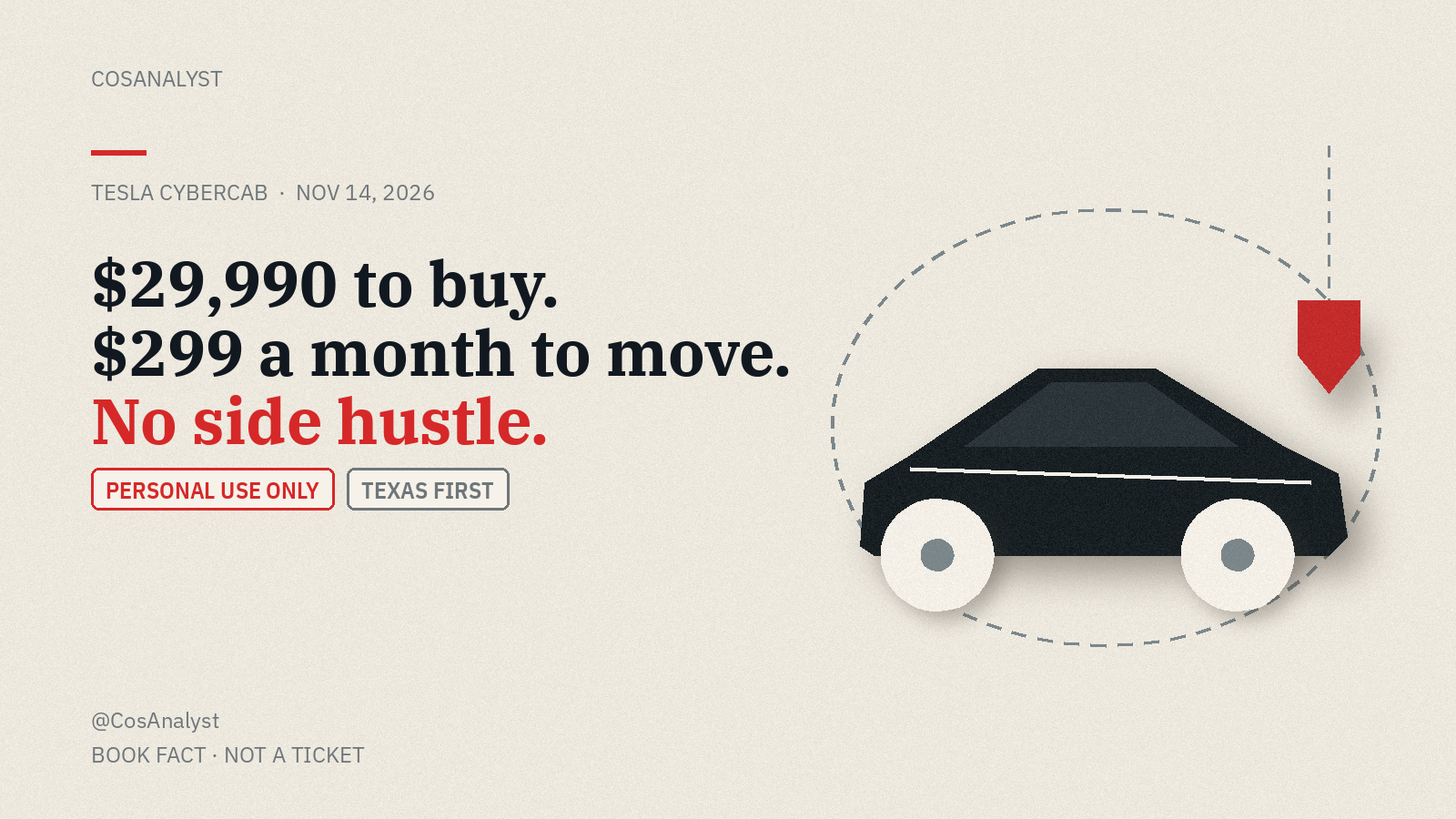
Musk promised a robotaxi for under $30,000 back in 2024. On Friday afternoon Tesla delivered the number: $29,990. Then came the fine print. The car will not move without a $299 monthly "Autonomy Subscription," it only drives inside Tesla's Robotaxi zones, and the terms say you cannot put it to work as a taxi. By late Friday night Musk himself said the monthly fee is "too high" (Tesla Robotaxi on X, Musk on X, Reuters).
So the dream of buying a $30,000 robot car and letting it earn money while you sleep is not what Tesla is selling today. Below: what the $299 actually covers, where it works, whether it is a good deal, whether a mini taxi economy is coming, who handles insurance, and what all of it means for TSLA stock.
What did Tesla announce?
- Price: $29,990 before taxes, Tesla's cheapest car ever, sold to "select customers" by invitation (InsideEVs, Electrek).
- Deposit: $1,000, non-refundable (Electrek, Teslarati).
- Required subscription: $299 a month, pre-checked on the order page, first month included. Order page fine print: "Subscription and regular vehicle maintenance required to operate" (Electrek).
- Delivery: estimated December 2026, Austin. A screenshot posted by YouTuber @MKBHD shows the delivery menu also lists Dallas, Fort Worth, Houston and San Antonio, with one car per customer (@MKBHD on X).
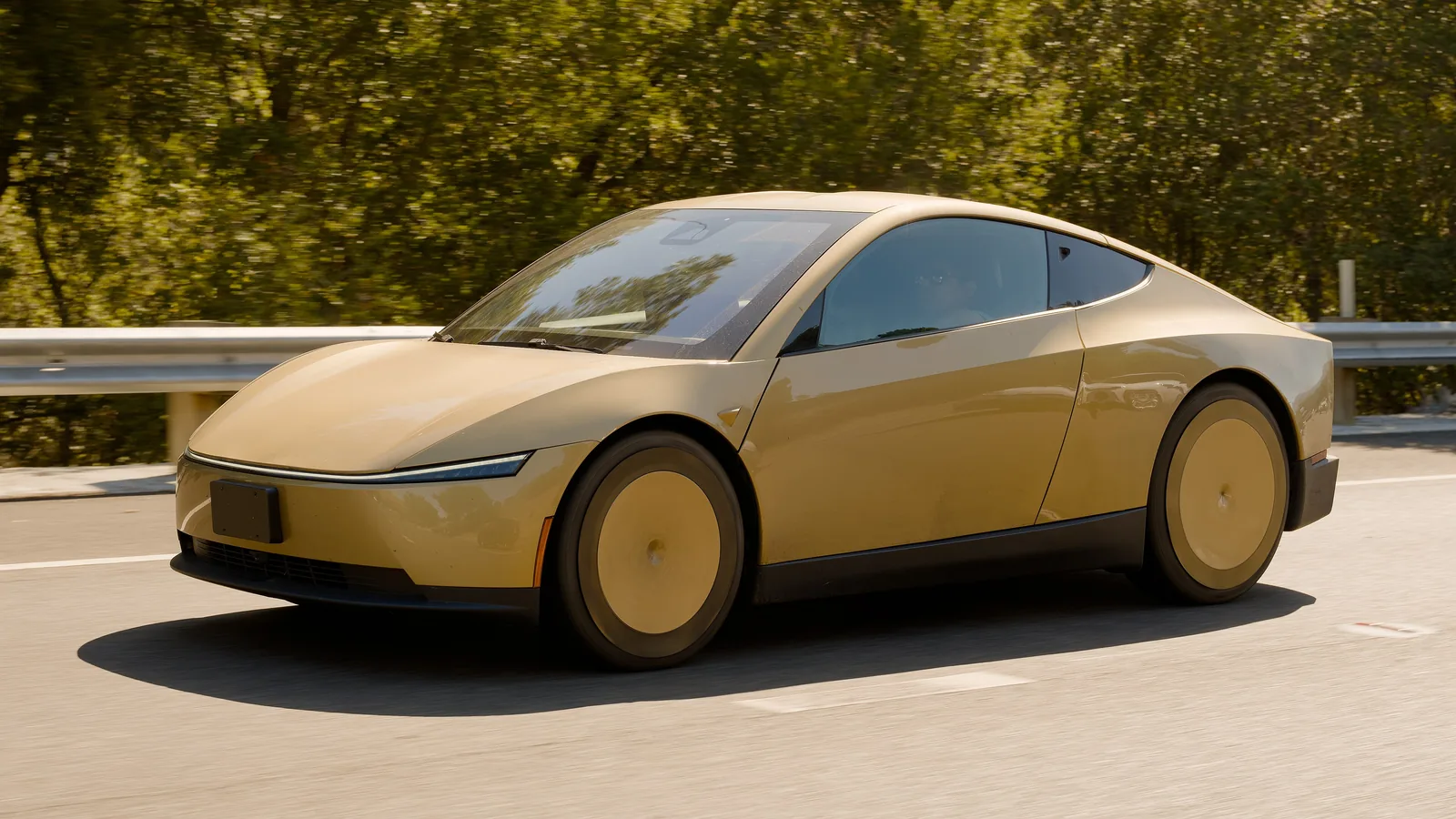
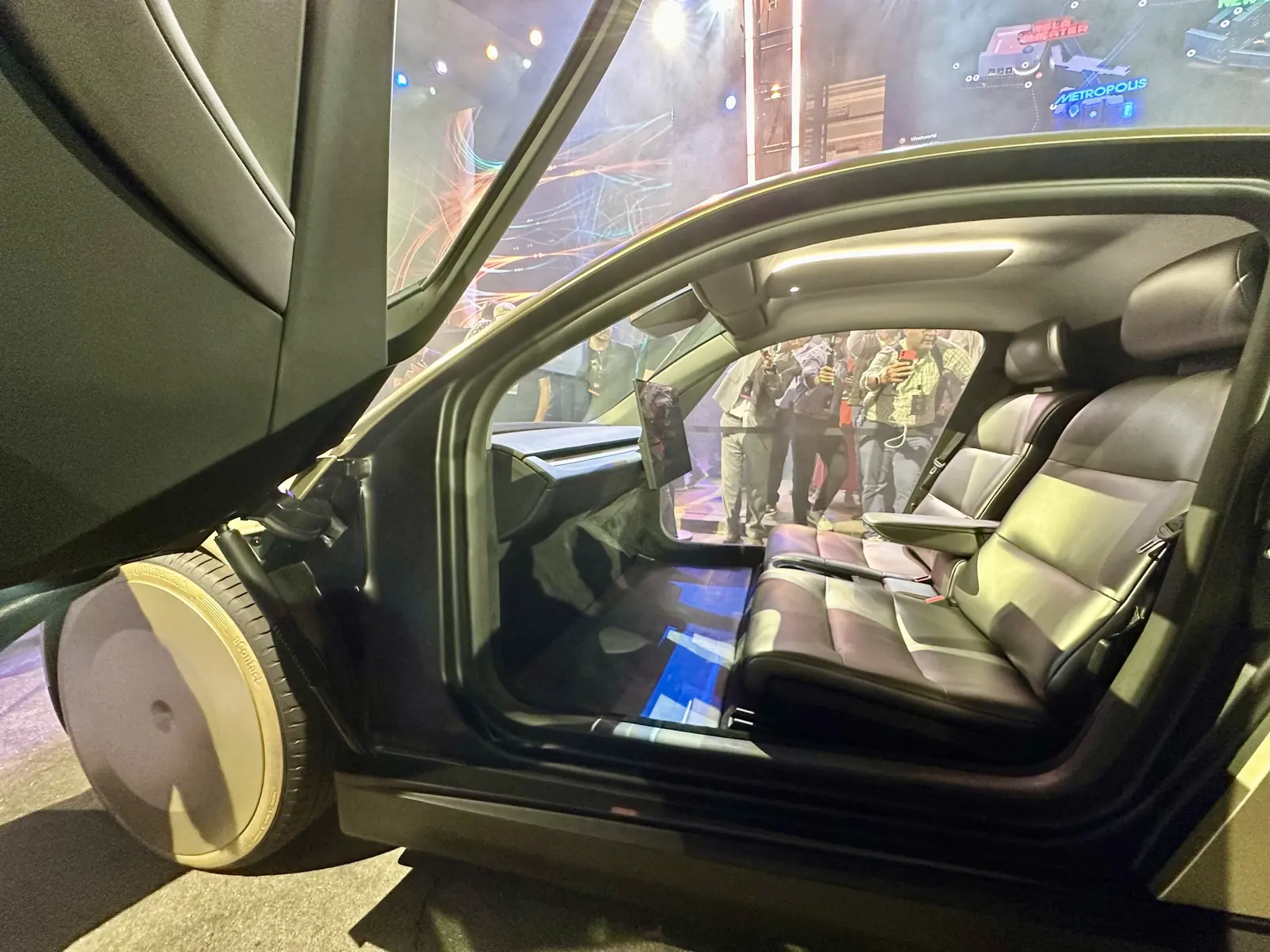
- The car: two seats, a 21-inch center screen, 20.1 cubic feet of cargo space, and no steering wheel or pedals (Electrek).

What does the $299 a month include?
It is not a lease and it is not insurance. It is a software and service subscription, and the car is useless without it. Page one of Tesla's Autonomy Subscription Agreement, under the heading "Subscription Required," says: "Your Cybercab will not operate without an active Autonomy Subscription."
Under "Subscription Coverage; Owner Responsibilities," the same page says the subscription includes "autonomous driving, vehicle connectivity, remote support, roadside assistance (including towing to or from a Tesla service center or your home address when needed, up to approximately 50 miles), and Covered Services." Then the other half: "You are responsible for registration, insurance, parking, charging, general cleaning and all other costs." Covered Services currently include tire and windshield replacement, wipers, cabin filters, washer fluid and camera cleaning (Tesla agreement page shared on X, Electronmotion).
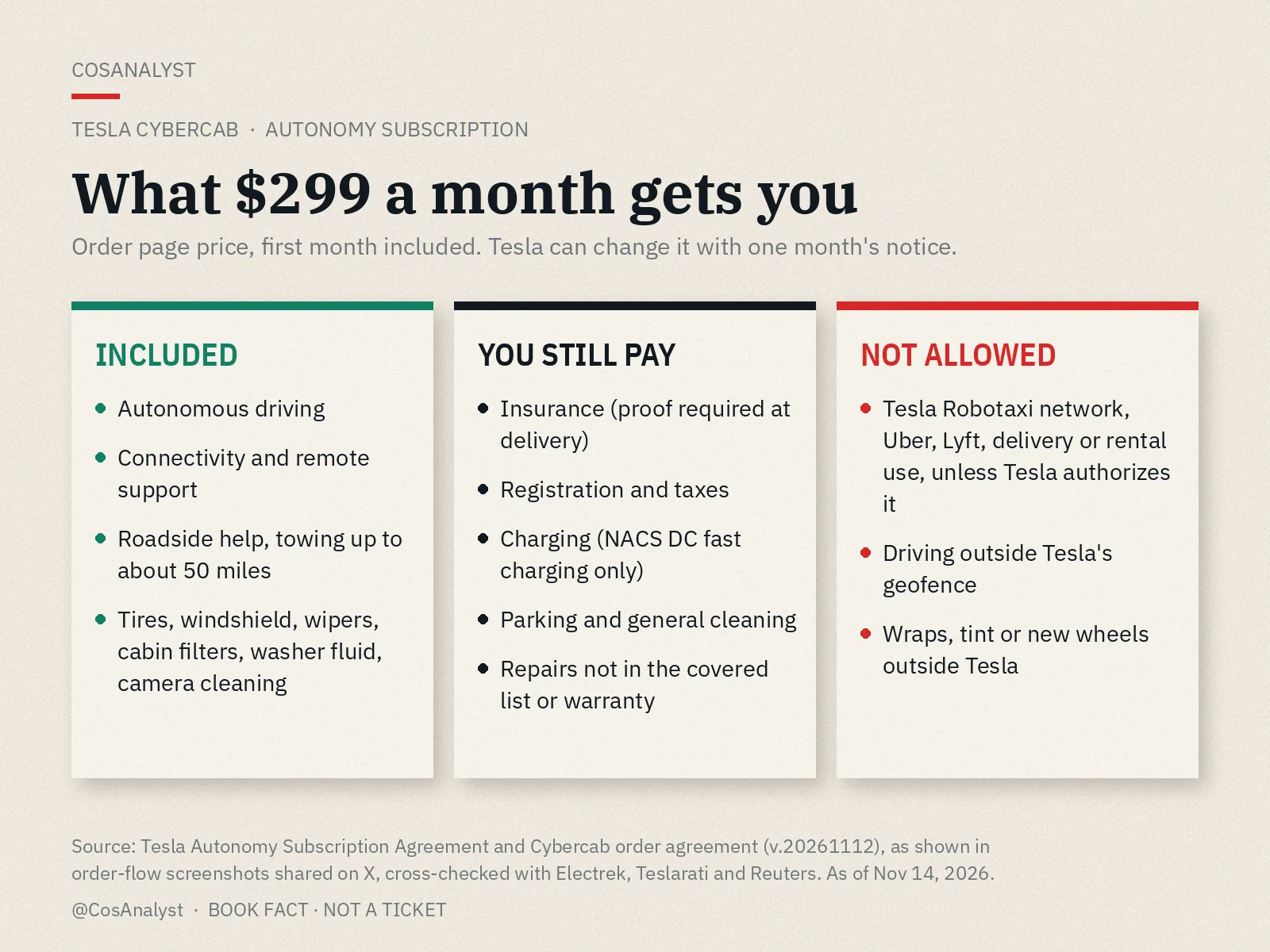
Two more things buyers should know. Tesla can change the price: the agreement lists no price, and the subscription can be repriced with a month's notice. It renews monthly and can be canceled anytime, but payments are not prorated (breakdown by X user @scotsrule08, Electronmotion). And the owner may want that cut: Musk wrote late Friday that the fee "should match the cost of Tesla FSD and connectivity for other models, which is more like ~$115/month." Tesla has not announced a new price (Musk on X).
Is there a lease or taxi agreement? We read what is public
There is no lease. You buy the car for $29,990 and subscribe separately. There is no public taxi or fleet agreement either. Tesla has never published terms, a revenue split or operator rules for outside owners on its Robotaxi network. Its September fleet interest form disclosed none (TechCrunch).
What exists are two documents buyers accept in the invite-only order flow: the Motor Vehicle Binding Order Agreement (Cybercab) and the Autonomy Subscription Agreement, both version 20261112. Tesla has not posted either one on a public tesla.com page that we could reach, so the best public view is the set of Tesla agreement pages posted on X: the Autonomy Subscription Agreement thread and the order agreement thread, both by X user @scotsrule08. We read the Tesla-letterhead pages directly and cross-checked the rest against Electrek, Reuters, Forbes contributor Brad Templeton and Drive Tesla. The agreements use bold clause headings, not numbered sections, so we cite the headings. The closest document Tesla does host publicly is its FSD (Supervised) subscription agreement (UK version). It covers a different, supervised product, not the Cybercab.
Key terms, line by line
- Term and price: month to month, cancel anytime, no prorating. No price in the agreement; the $299 comes from the order page.
- Down payment: $1,000 non-refundable order deposit. Taxes and fees are extra, and the order agreement's "Purchase Price, Taxes and Official Fees" clause warns they "could amount to up to 10% or more of the Vehicle purchase price."
- Mileage: no mileage cap in the subscription. Under "Pre-Delivery Road Testing," each car arrives with "approximately 250 miles on the odometer" and "these miles count toward any mileage limits in your warranty."
- Robotaxi network and ride revenue: "Your Cybercab is for personal, non-commercial use only." No Tesla Robotaxi, third-party ride-hailing, delivery or rental platform use unless Tesla "expressly authorizes it in writing or enables it in-product." So there is no ride revenue to split, and no split is published.
- Insurance: "You are solely responsible for obtaining and maintaining all required insurance." Proof is required at delivery, including for empty trips to charge or get serviced, and Tesla does not guarantee you can get coverage.
- Charging, cleaning, parking: all on the owner. The car only works with NACS DC fast charging, including Superchargers (Wonderful World of EVs).
- Wear and tear: tires, windshield, wipers and filters are covered. Unplanned repairs are not, unless the warranty covers them. Wraps, tint and wheel changes have to go through Tesla.
- Exit: cancel the subscription and the car stops. Under the order agreement you cannot sell or transfer it without Tesla's written consent. An unauthorized sale carries damages of the greater of $50,000 or the sale's full value, and Tesla can buy the car back at any time at a fair market value it sets (order agreement thread, Drive Tesla).
- Control: Tesla can locate, restrict or remotely control the car. Three or more unsafe-use "strikeouts" bring a one-week suspension with no refund (Forbes via Yahoo Finance, Drive Tesla).
Pros
- Under $30,000 for a car that drives itself, with no lease math or mileage cap.
- Maintenance is mostly bundled, and the car drives itself to service.
- Month to month, cancel anytime.
- Musk publicly wants the fee cut to about $115.
Cons
- No subscription, no car. You own a $29,990 object that only Tesla can switch on.
- Personal use only: no Robotaxi income, no Uber, no rentals.
- You carry the insurance on a car you cannot drive, and coverage is not guaranteed.
- Resale needs Tesla's permission, and Tesla can buy it back at its own valuation.
- Tesla can change the price, the terms and the map.
Is the Cybercab geofenced?
Yes, completely. The subscription agreement limits the car to "Tesla-enabled Robotaxi geofences" and says: "Operation outside the operating area is prohibited and may be technologically prevented." Tesla can expand, shrink or move that area, and it "may not match" the Robotaxi service map (@scotsrule08 breakdown, Electrek).
- Where: Tesla's Robotaxi runs in Austin, Dallas, Fort Worth, Houston and San Antonio in Texas, and Miami, Orlando and Tampa in Florida. Delivery is offered only in the five Texas cities for now (Electrek, @MKBHD on X).
- How big: Austin's service area was about 245 square miles as of June 2026 (TSLNA guide). But an independent tracker found Tesla actually accepts pickups in only 59% to 78% of the advertised zones in the six cities it checked, about 59% in Austin (Electrek).
- No manual escape hatch: with no steering wheel or pedals, you cannot drive it home from outside the zone. Touchscreen controls move it at up to 2 mph and are not meant for public roads (Electronmotion).
- Earning outside the zone: not possible, and not allowed inside it either under the personal-use terms.
- Expansion: Musk says it "will be available nationwide, as we receive regulatory approval," with no timeline. Tesla's AI chief says it works unsupervised in all the same locations as Robotaxi (Musk on X, Reuters).

Is the Cybercab a good deal?
The sticker is the cheapest Tesla ever. The full bill is the real number. At $299 a month with the first month free, year one costs $33,279 before tax, and five years cost $47,631, before insurance, registration, charging and parking. At Musk's suggested $115, five years would be $36,775 (CosAnalyst math from the order page price).
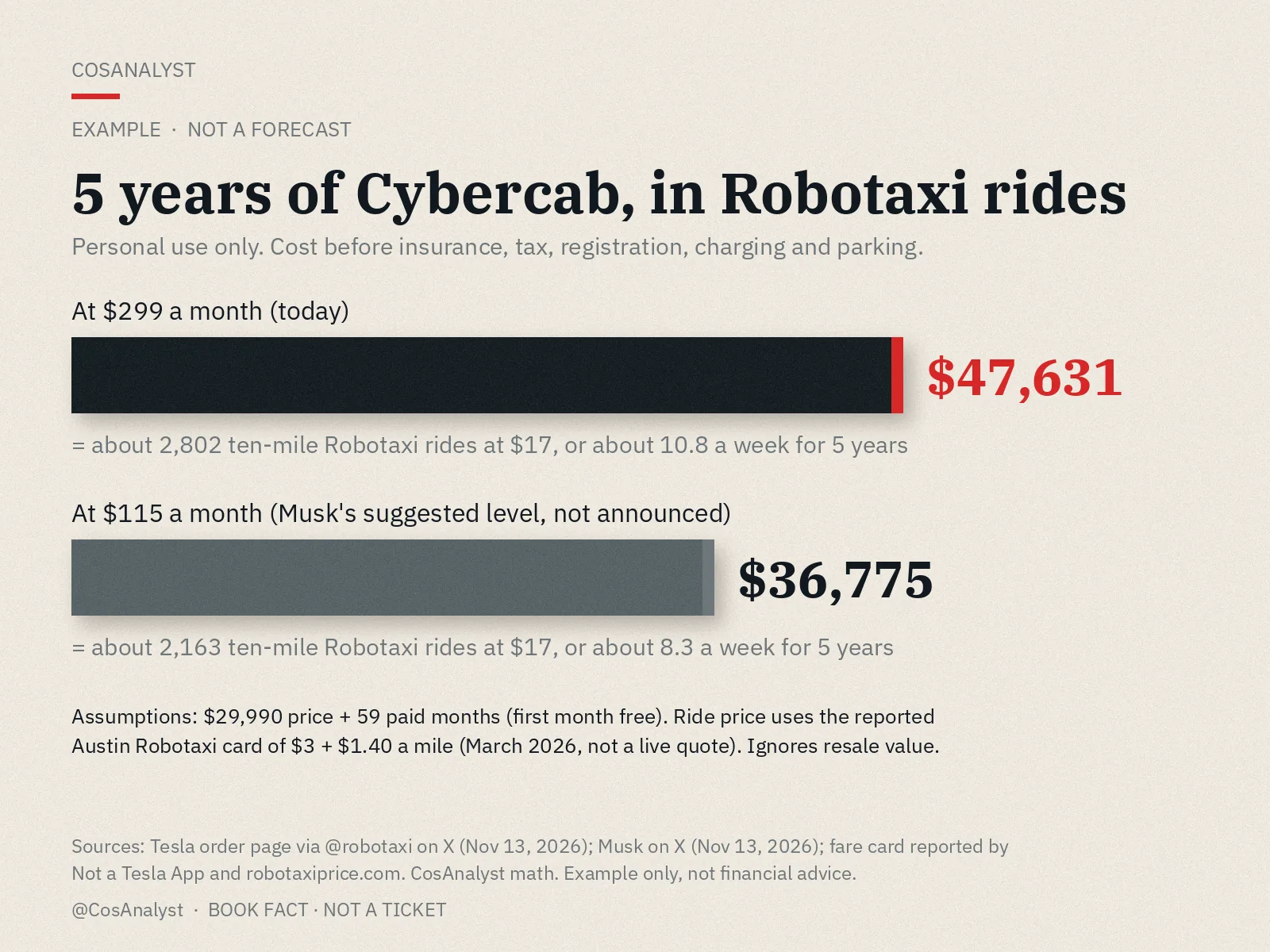
Compare that with just calling a Robotaxi. Austin's reported fare card is $3 plus $1.40 a mile, so a ten-mile ride is about $17 (Not a Tesla App). One Austin route on launch weekend priced a Cybercab ride at $7.77 versus $12.10 in a Model Y (robotaxiprice.com). Five years of owning at $299 equals roughly 2,800 ten-mile rides, about 11 a week, before you pay a dime of insurance.
- Good deal if: you live and work deep inside the zone, already spend well over $300 a month on rides, and value having your own car waiting. Electrek's editor concedes the math can work on paper for that person (Electrek).
- Bad deal if: you leave the zone, need more than two seats, want to resell, or were hoping it pays for itself. For most buyers, renting the ride beats owning the car.
Verdict: a good collector's toy and a so-so commuter, not an investment. If Tesla cuts the fee to about $115 and opens the network to owners, the math changes. Today it does not.
Will Cybercab create a taxi economy for mini entrepreneurs?
Not yet, and Tesla's own paperwork is the reason. The car is personal use only, and the order agreement says only the registered owner may use it, while riding along (Wonderful World of EVs). On Tesla's October earnings call, Musk said "the vast majority" of Cybercabs would stay Tesla-owned (Electronmotion, Teslarati).
The door is not shut. Tesla's AI chief said customer cars could start joining the Robotaxi fleet "somewhere around Q2 next year" (The Verge), and Tesla is collecting interest from businesses that want to buy Cybercab fleets (TechCrunch). No revenue split for owners has been published.
Illustrative only. If Tesla ever allowed it, the owner math starts with covering $299 a month plus the car itself. Spread $29,990 over five years with no resale value and that is about $500 a month, so roughly $800 a month before Tesla's unknown cut, insurance, charging and cleaning. At an example $1 a mile, about the early reported Cybercab fare, that is around 800 paid miles a month just to break even on those two lines. Every number in that sentence except the $299 and the $29,990 is an assumption.
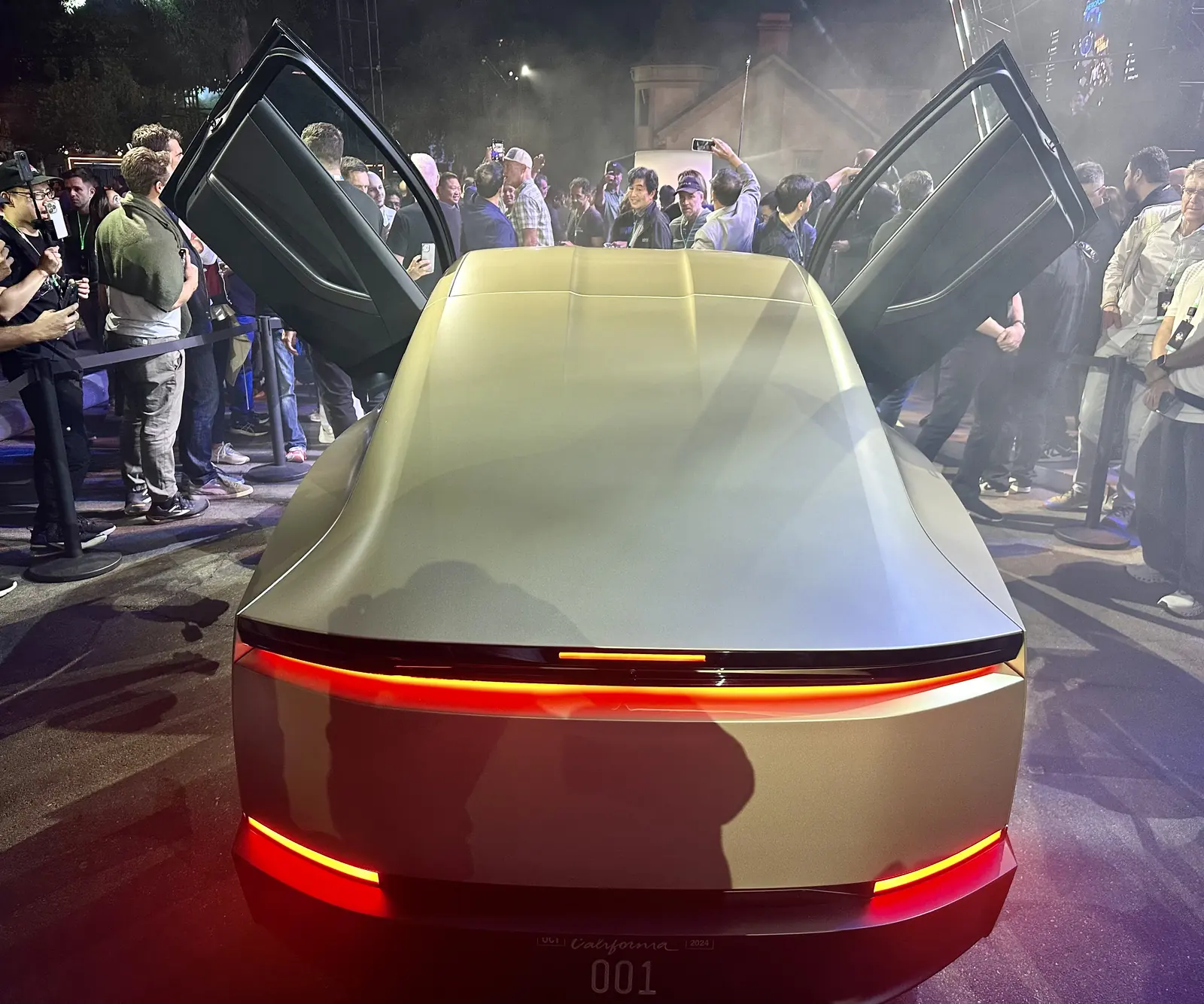

Who insures a Cybercab, and does Tesla make money on it?
The owner insures it, and finding a policy is the owner's problem. Tesla's order agreement says it does not guarantee insurance will be available. Tesla Insurance does sell policies in Texas and Florida (Tesla Insurance), but Tesla has not announced a Cybercab policy or price. Forbes contributor Brad Templeton notes that with no controls, any at-fault crash points at Tesla's driving system, and it is unclear what other insurer would write the policy until safety data is published (Forbes via Yahoo Finance).
So, will Tesla make money on Cybercab insurance? Possibly, if it becomes the default insurer for a car only it really understands. But no Cybercab policy exists yet, Tesla has not said what one would cost, and the bigger money for Tesla here is the recurring $299, not premiums. An owner cannot make money on the insurance at all.
What does this mean for TSLA stock?
The Robotaxi post went up at about 3:27 PM PT Friday, after the close. TSLA had already closed at $390.22, down 1.8%, but up about 9% for the week. It traded at about $387.11 after hours, down 0.8% (TradingView, Nov 13 close and after-hours).
Is TSLA a buy here? The bull case vs the bear case
The numbers, as of Friday's close (TradingView, pulled about 1:15 AM PT Nov 14): market cap about $1.54 trillion, about 429 times trailing earnings, about 232 times next year's estimated adjusted earnings of $1.68 a share, and about 13.6 times sales. The stock is down about 15% this year, with a 52-week range of $297.38 to $498.83. Of 49 analysts, 23 say hold, 23 buy or overweight and 3 sell. The average price target is about $424, with a high of $600 and a low of $157.
The bull case
- Robotaxi as a platform: Tesla started Cybercab rides in Austin on Sept. 3 and says cumulative unsupervised Robotaxi miles grew eightfold quarter over quarter (Tesla Q3 2026 update).
- A cheap vehicle to scale it: a $29,990 purpose-built car with recurring software revenue on top is the cost structure bulls have waited for.
- Optimus: Musk said on the Q3 call that early production has started on a Fremont line built for 1 million units a year, and that reaching 20,000 robots a week takes "probably at least a year, maybe a little longer" (Q3 call transcript).
- Energy: Tesla reported its highest-ever storage order rate and backlog, driven partly by data centers, and Megafactory Texas began production with 50 GWh of planned capacity (Tesla Q3 2026 update).
- Software margins: FSD and the Cybercab subscription are monthly software revenue on cars already sold. Services and other revenue rose 33% from a year earlier in Q3 (CNBC).
The bear case
- Valuation vs. the car business: Q3 automotive revenue fell 3% to $20.56 billion, and GAAP net income was $787 million versus $1.37 billion a year earlier (CNBC, Tesla Q3 2026 update). At over 200 times forward earnings, the car business alone does not explain the price.
- China: Tesla sold just 8,817 cars to Chinese buyers in October, down 66%, and fell out of the top 10 NEV brands while BYD held 22.4% of the market and Xiaomi climbed to sixth (CnEVPost, Electrek).
- Regulation and execution: NHTSA has asked Tesla to show that a car with no brake pedal meets federal safety rules and has not ruled (Electrek). The Cybercab works only where Tesla has approval, and the actual service zones are smaller than advertised.
- Key-person risk: the whole optionality story runs through one CEO, whose timelines have repeatedly slipped. Musk predicted "a million robotaxis" by 2020 (Stocktwits via Yahoo Finance).
- Macro: a stock priced on 2030 profits is the first thing sold when rates or recession fears rise.
If the economy crashes, muddles along or rips
| Scenario | Under 1 year | 1 to 3 years | 5+ years |
|---|---|---|---|
| Economy crashes | High-multiple stocks usually get hit first; car demand and subscription signups soften | Cash and energy backlog matter most; robotaxi and Optimus spending gets questioned | Thesis survives only if autonomy and Optimus ship at scale |
| Base case | Trades on Robotaxi headlines, fee changes and NHTSA rulings | Owner-fleet launch (targeted around Q2 2027) and Optimus ramp decide the multiple | Platform or car company: the market picks one |
| Economy rips | Risk-on money chases the robotaxi story | More cities, cheaper fee, faster rollout get rewarded | Bulls' upside case: robotaxi, Optimus and energy all scale |
Qualitative scenarios only, not price targets or predictions. CosAnalyst analysis.
Our take
Here is the honest version. You are not paying $390 for a car company. Tesla's car business is shrinking in China, flat in revenue and earning a fraction of what it did a year ago. If you only want an innovative carmaker, the price makes no sense.
What you are paying for is optionality: robotaxis, Optimus and energy storage. Friday's Cybercab launch is a real step, a $30,000 driverless car with a recurring fee. But read the contract. Tesla kept the taxi business for itself, and it kept the off switch. That tells you where it thinks the value lives.
If you believe robotaxi and Optimus scale in the next five years, short-term crashes are noise and the time horizon has to be long. If you need this to work in 12 months, the stock is priced for perfection and a recession would hurt. Our view: own it only as a long-horizon bet on the platform, sized so you can sit through a 40% drawdown. Do not buy it for the car business alone.
FAQ
How much does the Tesla Cybercab cost?
$29,990 before taxes, plus a required $299 a month Autonomy Subscription with the first month included and a $1,000 non-refundable deposit. Year one is $33,279 before tax and insurance.
What is included in the $299 a month?
Autonomous driving, connectivity, remote support, roadside assistance with towing up to about 50 miles, and covered maintenance like tires, windshield, wipers and cabin filters. Insurance, registration, charging, parking and cleaning are extra.
Is the $299 a lease?
No. You buy the car and pay a separate monthly software subscription. No Cybercab lease has been announced.
Is the Cybercab geofenced?
Yes. It only operates inside Tesla-enabled Robotaxi zones, and operating outside them is prohibited and may be blocked. Deliveries start in Austin, Dallas, Fort Worth, Houston and San Antonio. It has no steering wheel or pedals, so you cannot drive it outside the zone.
Can I make money with a Cybercab on the Robotaxi network?
Not now. The subscription terms limit it to personal, non-commercial use unless Tesla authorizes otherwise in writing or in the app. Tesla has published no revenue split for owners.
Who insures a Cybercab?
The owner. Proof of insurance is required at delivery, and Tesla does not guarantee coverage will be available. Tesla has not announced a Tesla Insurance policy for the Cybercab.
Will the Cybercab subscription get cheaper?
Maybe. Musk said the fee is too high and should be closer to $115 a month, but Tesla has not changed the price.
Not financial advice. This is analysis, not a recommendation to buy or sell TSLA or any vehicle. Agreement terms are from Tesla documents as shown in order-flow screenshots shared publicly on X (version 20261112) and may change. Owner economics are labeled examples with stated assumptions. Prices as of the Nov 13, 2026 close.
Follow @CosAnalyst on X, like the CosAnalyst Facebook Page, and join our Telegram at @CosAnalystSignals.
Your call: Car company or robot company: which one are you paying for at $390? And would you buy a $29,990 Cybercab you can't drive, rent out or resell without Tesla's OK? Pick a side in the comments.