
Research · research feature
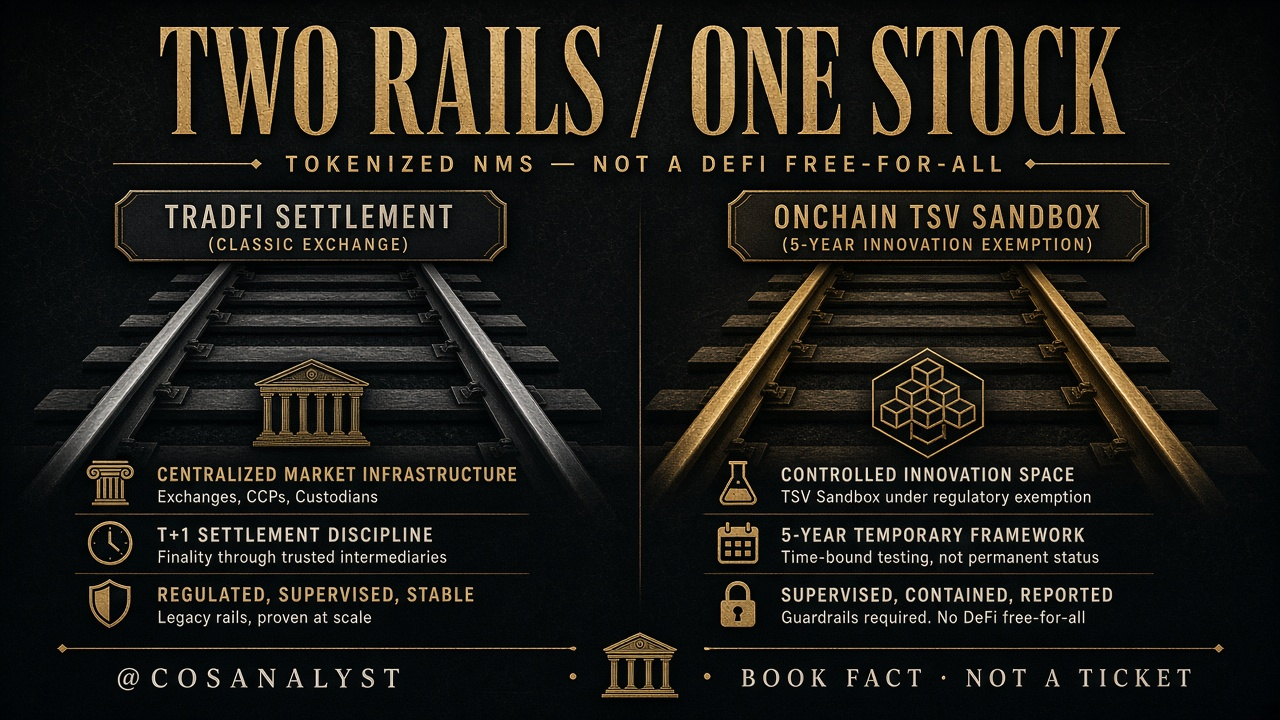
The innovation exemption is not about 24/7. It’s about who gets to clear the next stock rail.
Tokenized NMS stocks just got a five-year onchain sandbox. Here’s the Cos map for crypto stocks and brokers — structural optionality, not a ticket.
The headline is 24/7 stocks.
That is the industry pitch — overnight trading, faster settlement, self-custody, fractional slices. It is also the sentence most people will stop at. Cos is not going to sell you a new bell.
On Thursday, September 17, 2026, the Securities and Exchange Commission issued a time-limited order that lets tokenized versions of stocks listed on major U.S. exchanges trade onchain. Commissioner Hester M. Peirce called it the innovation exemption. Chair Paul S. Atkins said the Commission is taking a significant step, within its statutory authority, “to bring America’s capital markets into the digital age.” The order landed days after the Senate failed to advance the crypto market-structure bill.
The useful question is not whether the market never sleeps. It is who gets to clear the next stock rail — and whether the companies whose names sit on those tokens even allow it.
BOOK FACT · NOT A TICKET. This page is a map of an order, not a Coinbase or Robinhood target.
What is happening
Translate the nouns once, then keep them.
NMS stocks are National Market System stocks: the listed names that already trade on the big U.S. exchanges. Tokenized, here, means a digital token that is supposed to be the share — same rights — not a side bet on the share. Onchain means that token changes hands on a blockchain. A Tokenized Securities Venue, or TSV, is the new category: a permissioned venue that runs automated market maker liquidity pools (an AMM prices by formula and pool inventory, not a floor specialist) and sets who is allowed in.
Peirce’s statement is the Cos primary. The order:
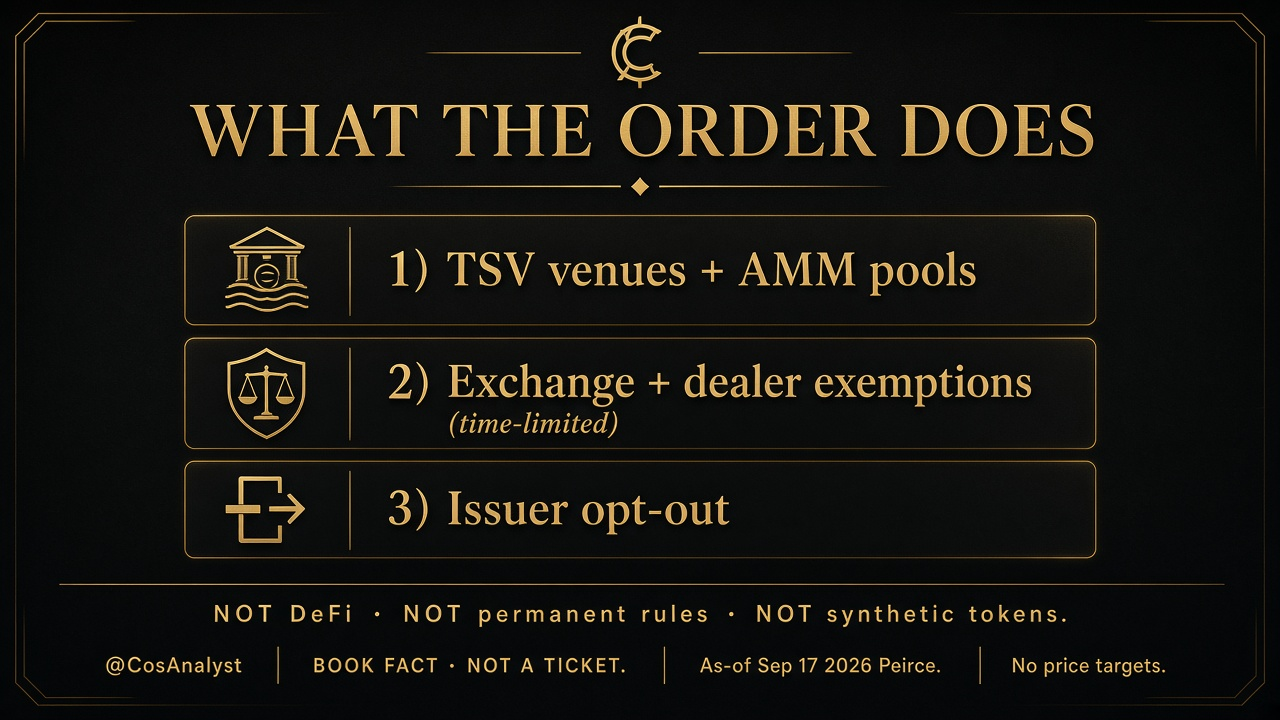
- Grants time-limited exemptions so those listed stocks can trade onchain.
- Exempts TSVs from the definition of “exchange” under the Securities Exchange Act of 1934 — the statute that decides who has to register and run like NYSE or Nasdaq.
- Exempts certain liquidity providers that supply those TSV pools from the definition of “dealer.”
- Lets tokenized NMS stocks trade inside those TSV environments.
- Lets issuers opt out. If the company does not want a tokenized version of its stock on a TSV, it can block it.
- Is available to U.S. persons, including incumbents and new entrants. This is not a private hall pass for one brand.
The Commission, Peirce said, does not presume that anyone relying on the exemption is therefore an exchange or a dealer. It wants to watch first: how tokenized NMS stocks trade onchain, and how that rail interacts with the traditional market — then write durable rules. Atkins called it a bridge, not a finished codebook.
Reuters adds the clock and the product fence Cos will keep on the board:
- The window is five years.
- Platforms must notify issuers before listing tokenized versions, and they are barred if the issuer objects.
- Synthetic tokens — derivative exposure that tracks a stock without being the stock — are not permitted.
- Tokenized stocks must offer the same rights and privileges as the traditional security, including dividends and voting.
Peirce is also explicit about what the order is not. It is not about decentralized finance. Permissionless peer-to-peer smart contracts, she wrote, do not need this exemption. Other trading models are welcome; some may already fit the Exchange Act and need no relief at all.
She paired the order with the Division of Trading and Markets’ April 13, 2026 staff statement on broker-dealer user interfaces used to prepare transactions in crypto asset securities. That pairing is part of the map: venue relief on one side, interface questions on the other.
Reuters reports Coinbase has signaled interest in a U.S. launch when the rules allow, and that Robinhood and Kraken already offer tokenized stocks overseas. That is a product-path fact, not a Cos fill.
Why it matters
If you stop at 24/7, you will misread the order. Overnight hours are a sales sentence. The mechanism is a temporary carve-out so 1:1 tokenized NMS names can trade on a permissioned onchain venue without the full classic exchange hat, and without forcing every pool liquidity provider into the full classic dealer hat, while the Commission watches whether the rail works.
A circulating whiteboard (Kevin, YouTube — Cos is translating the chain, not endorsing the trade) is useful if you keep his leverage in a CONTESTED box.
His mechanism read: a young token venue cannot be forced to behave like a mature national market on day one. He leans on Rule 611 — the 2005 “trade-through” rule — and NBBO, the National Best Bid and Offer, the public best displayed price across listed venues. Routing toward that best price is the listed-market retail protection story. On an immature token pool, he argues, that same discipline would strangle the experiment. That Rule 611 / NBBO friction is Kevin’s mechanism read of why the exemption matters for token venues. It is not a sentence Peirce wrote. Cos will not upgrade it to a Commission fact.
Then his flow thesis, labeled as such:
- CONTESTED — unified margin. Bitcoin holders who will not sell (tax) and will not lever a pure-crypto book (volatility) might one day sit tokenized equities beside crypto collateral and borrow against a calmer mix. That is a flow story, not a Cos forecast. Any “untaxed bitcoin waiting to lever into stocks” figure in that video is Kevin’s framing as contested color, not a Cos fact.
- CONTESTED — broker economics. In his chain, a broker or crypto broker custodies the share, mints a 1:1 token, and moves the liquidity onchain. If token venues run wider spreads than the listed tape, payment-for-order-flow and spread capture could look more like options or crypto than like tight-stock pennies. Possible. Not proven. Not a Cos P&L.
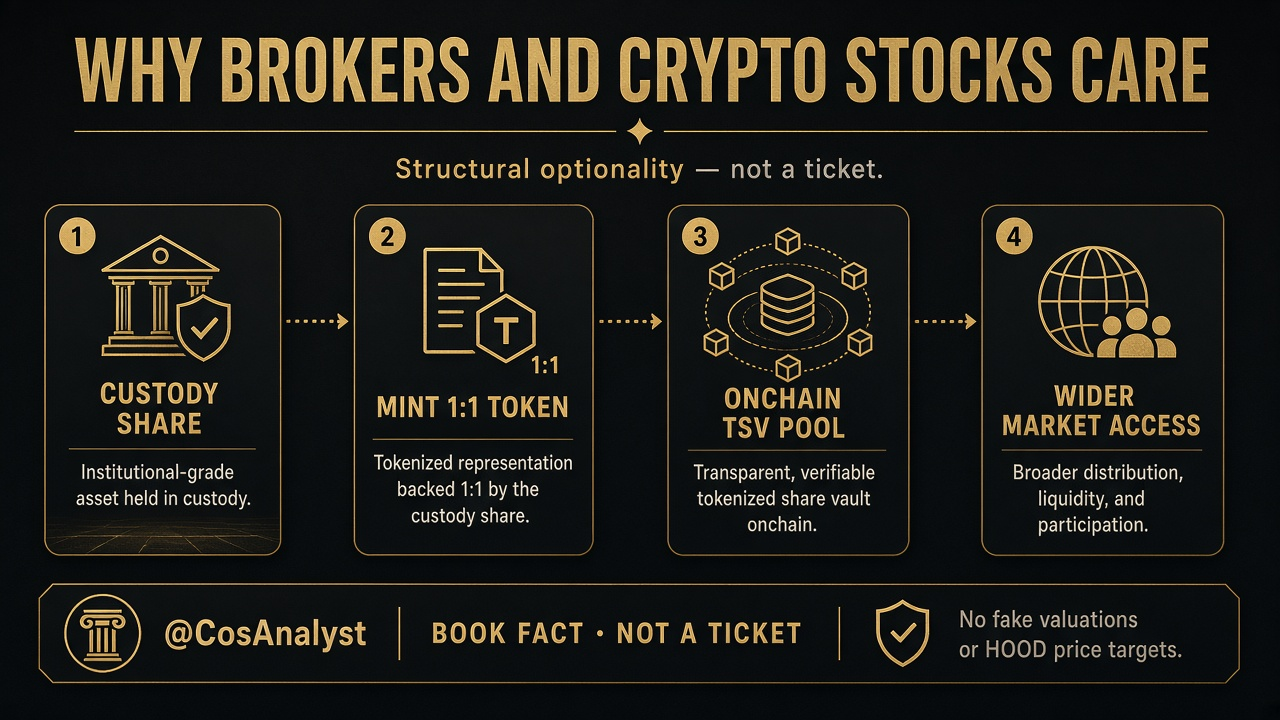
Why Coinbase and Robinhood still belong on the map, without a target: Peirce said incumbents and new entrants are eligible. The exemption is a U.S. onshore path for a product already explored overseas — with a harder product rule. Synthetics do not qualify. Same rights do.
CONTESTED — analyst color, not Cos: a long-term competitive read versus traditional brokerages (Morgan Stanley’s E*TRADE, Charles Schwab) is circulating because if a permissioned onchain rail ever carries real 1:1 stock flow, distribution and custody are what get competed over. Optional structure, not a 2026 revenue print.
The industry will keep selling 24/7, instant settlement, self-custody, and fractional. Label that as the pitch. Cos is not forecasting that those features win the five-year window.
Two paths, not a call
A — The sandbox is used. Venues file as TSVs. Liquidity providers show up. A workable set of names get tokenized 1:1, issuers do not blanket-veto, and the Commission gets the onchain-versus-listed interaction data it said it wants. Crypto brokers and listed brokers both have a U.S. product path. The April interface staff statement gets tested in public. Not a ticket — the path where the exemption was not a press release.
B — The sandbox yawns. Issuers opt out of the names people actually want. Pools stay thin. Spreads stay embarrassing next to the listed market. Synthetics stay offshore — a different product. The Clarity / market-structure bill either returns and supersedes the experiment or stays stuck, and the five-year clock becomes a curiosity. Traditional brokerages feel no distribution threat. Crypto names keep the optionality and not the volume.
Neither path pays you for guessing HOOD or COIN from this page. Cos is not printing those targets.
Watch list
No Cos-stamped tape levels on this story. The usable board is process:
- Who files as a TSV. Incumbent, crypto native, or someone new. Peirce left that door open on purpose.
- Which issuers opt out. The veto is the real supply switch. A sandbox with only the names nobody fights over is not a rail.
- April UI staff statement follow-through. Venue relief without a usable interface is a museum exhibit.
- Clarity / legislation versus the exemption path. Atkins tied this order to a bill that did not advance. Watch whether Congress writes the durable rule, or the Commission keeps observing.
- Traditional broker versus crypto broker competition. Distribution, custody, and who mints the 1:1 token. CONTESTED as a P&L story; live as a product-path story.
What next
The Commission asked for comment. The exemptions expire five years after publication. Peirce’s closer is the Cos closer: an interim step toward a tokenized tomorrow, not the mythology.
What Cos will grade from here is boring on purpose. Filings. Opt-outs. Whether the tokens are actually 1:1 with rights. If those three stay empty, the 24/7 headline was always the product.
BOOK FACT · NOT A TICKET. Publisher + AI-assisted. Simulated research. Not a recommendation, not a fill, not a Coinbase or Robinhood price target.
Sources / as-of
As-of: Fri Sep 18, 2026, evening PT.
- Peirce, “Slumber Number: Innovation Exemption Statement,” Sep 17, 2026 — sec.gov
- Atkins, “Statement on the Innovation Exemption: A Bridge Toward Durable Rulemaking,” Sep 17, 2026 — sec.gov
- SEC press release 2026-90, Sep 17, 2026 — sec.gov
- Reuters, “US securities regulator rolls out five-year exemption for tokenized stock trading,” Sep 17, 2026 — reuters.com
- SEC staff, “Staff Statement Regarding Broker-Dealer Registration of Certain User Interfaces Utilized to Prepare Transactions in Crypto Asset Securities,” Apr 13, 2026 (cited by Peirce)
- Kevin (YouTube, educational whiteboard Cos is translating, not endorsing) — youtu.be/FVM4MN7raH0
- No Cos-stamped tape levels. No Coinbase or Robinhood price targets. BOOK FACT · NOT A TICKET.